Watercolor on vellum, probably painted around 1700, attributed to Johanna Helena Herolt Graff (Frankfurt 1668 -1723 Surinam). Johanna Helena was the oldest daughter of Maria Sybilla Merian, she was married to the painter Johann Andreas Graff in Amsterdam. Maria Sybilla Merian had two daughters. The elder one of them, Johanna Helena married in Amsterdam the merchant Jacob Hendrik Herolt with whom she moved to Paramaribo, the capital of Surinam in South America. Johanna Helena Herolt, born as Graff, the older daughter of Maria Sibylla Merian (1647-1717), created numerous lavishly crafted gouaches. In doing so she has recombined individual motifs from existing drawings, among them are watercolours of flowers, flower bouquets and some of plants in combination with images of snakes or spiders. She was particularly well-versed in the drawing of flowering plants, and therefore worked like her mother for the collector Agnes Block and on behalf of the botanical garden ,Hortus Medicus' in Amsterdam. After Maria Sibylla Merian traveled to Surinam with her younger daughter Dorothea Maria (1678-1743) in the years 1699-1701 to draw plants and insects, Johanna Helena moved with her husband, the Amsterdam merchant Jakob Hendrick Herolt, in 1711 also there. In 1723 she passed away probably in Surinam.
Original antique copper engraving. Basilius Besler (1561–1629) was a respected Nuremberg apothecary and botanist, best known for his monumental Hortus Eystettensis. He was curator of the garden of Johann Konrad von Gemmingen, prince bishop of Eichstätt in Bavaria. The bishop was an enthusiastic botanist who derived great pleasure from his garden, which rivaled Hortus Botanicus Leiden among early European botanical gardens outside Italy. The gardens surrounded the bishop's palace, Willibaldsburg, which was built on a hill overlooking the town. These gardens had been started in 1596 and designed by Besler's colleague, Joachim Camerarius the Younger (1534–1598), a physician and botanist. Upon Camerarius' death in 1598, Besler had the remainder of Camerarius' plants moved to Eichstätt and carried on the work of planting and supervision. The bishop commissioned Besler to compile a codex of the plants growing in his garden, a task which Besler took sixteen years to complete, the bishop dying shortly before the work was published. The gardens were sacked by invading Swedish troops under Herzog Bernhard von Weimar in 1633-4; following Hortus Eystettensis they have been reconstructed and opened to the public in 1998. (Wikipedia)
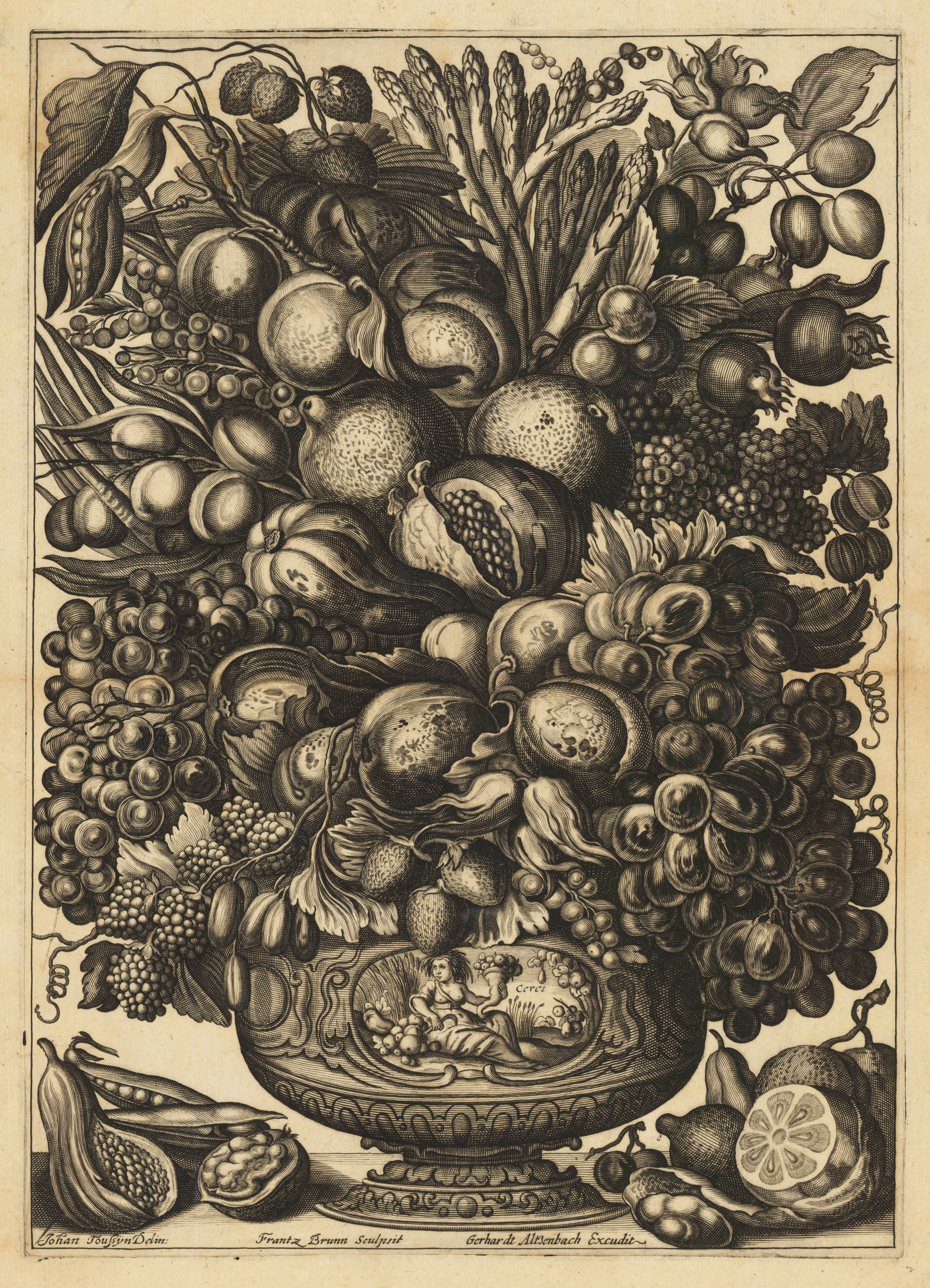
Original antique copper engraving, uncolored published. This fine decorative antique engraving shows a bunch of fruits with grapes, strawberries, pomegranates, raspberries, gooseberries, asparagus, blueberries, lemons, currants and many more fruits in a bowl.
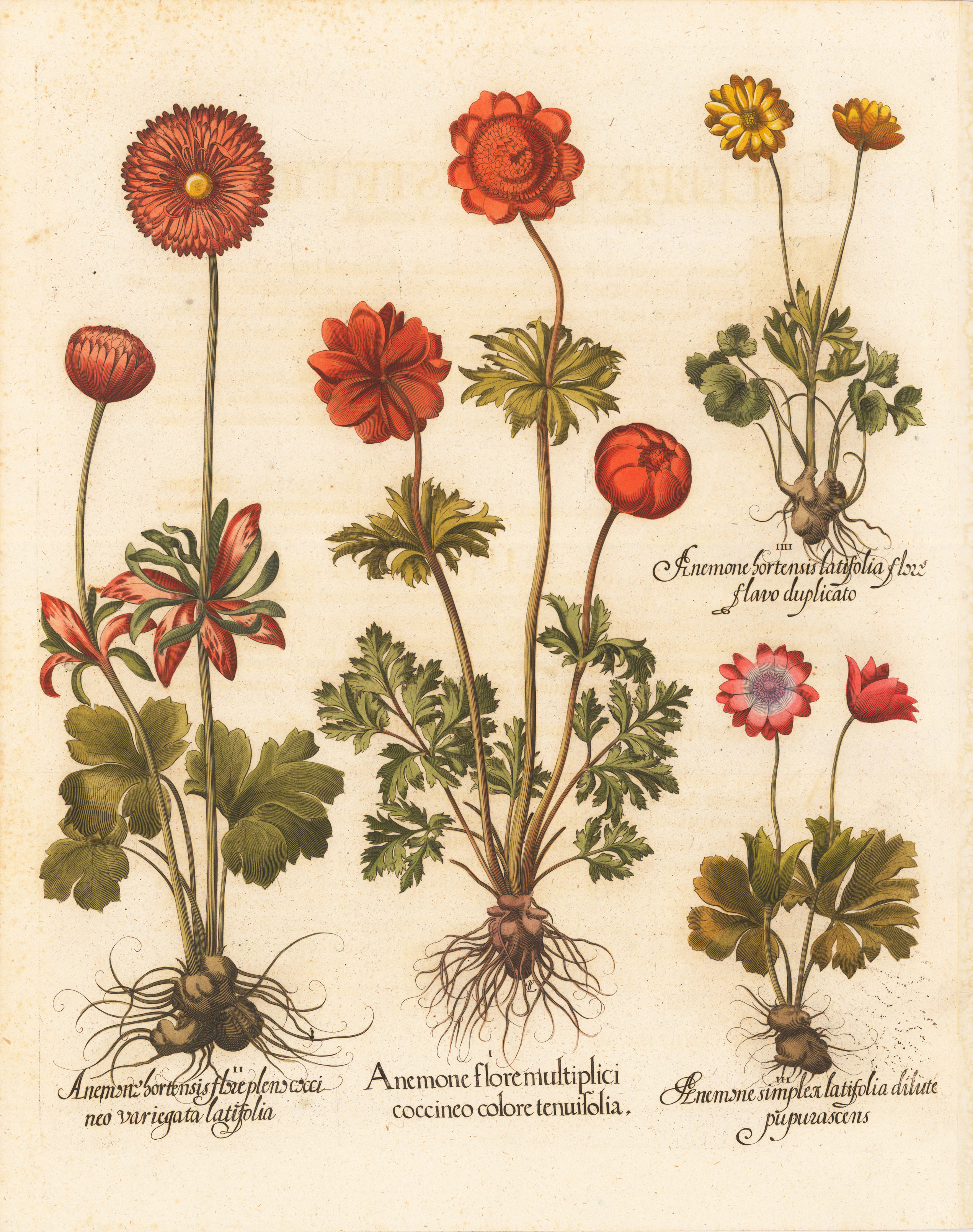
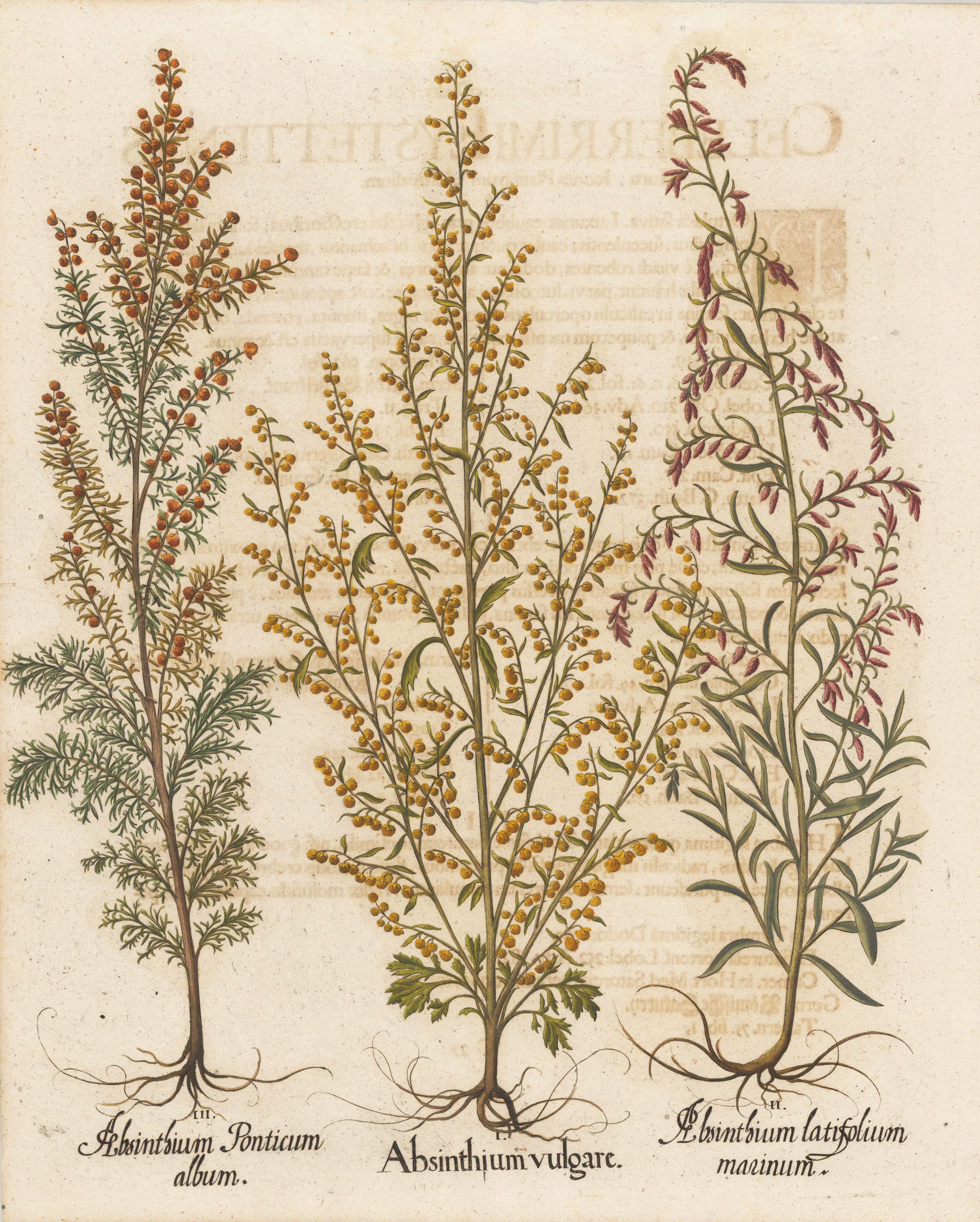
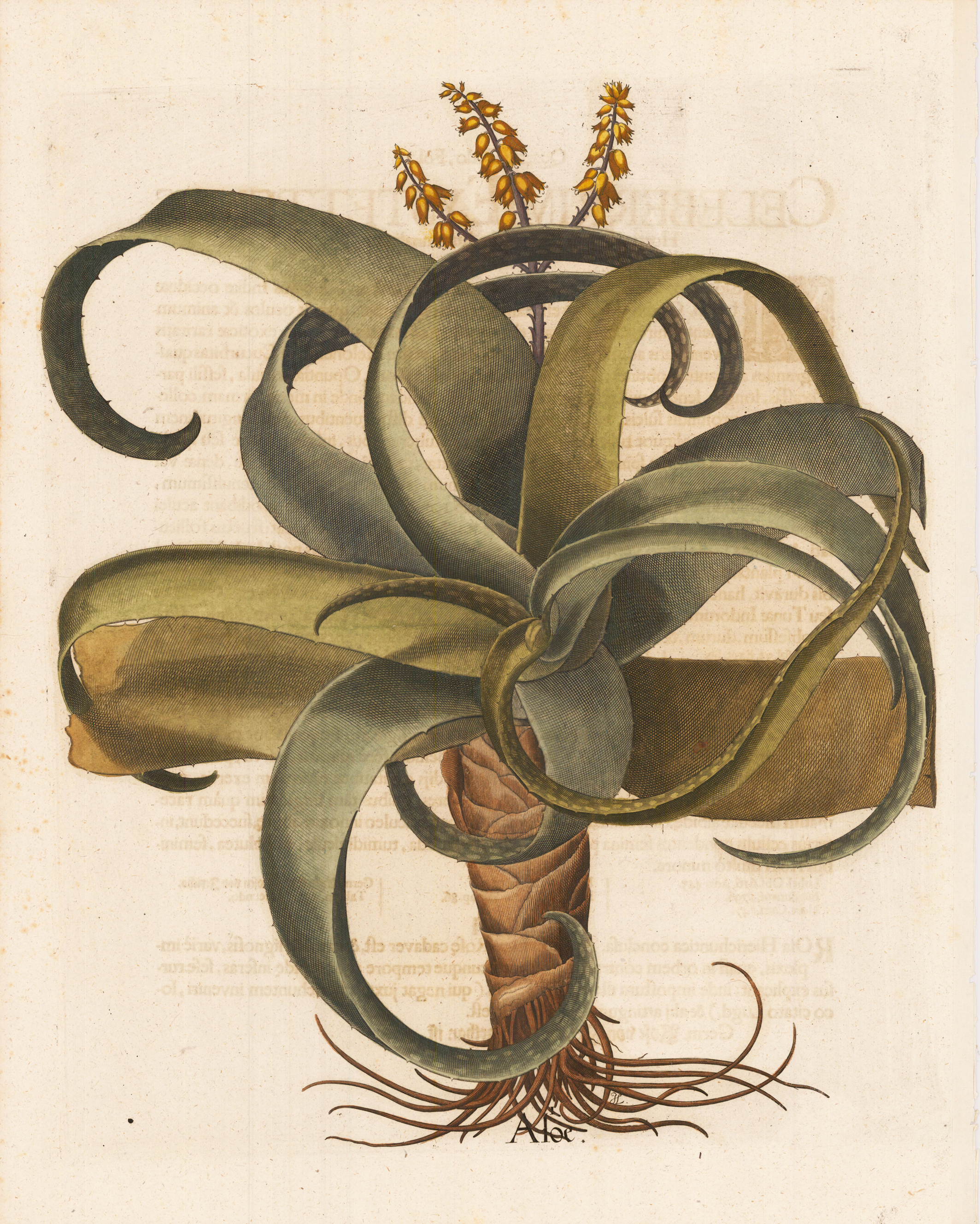
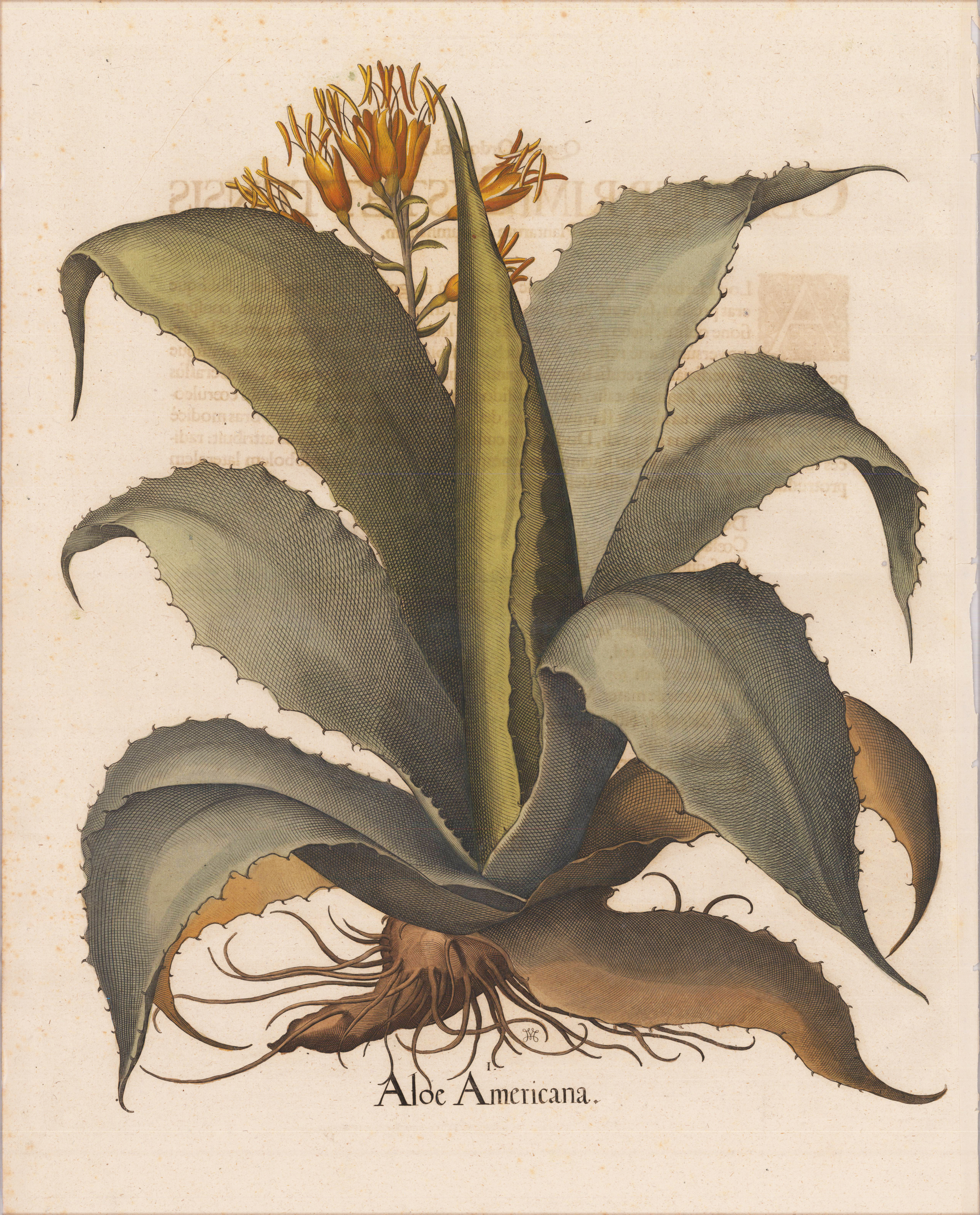
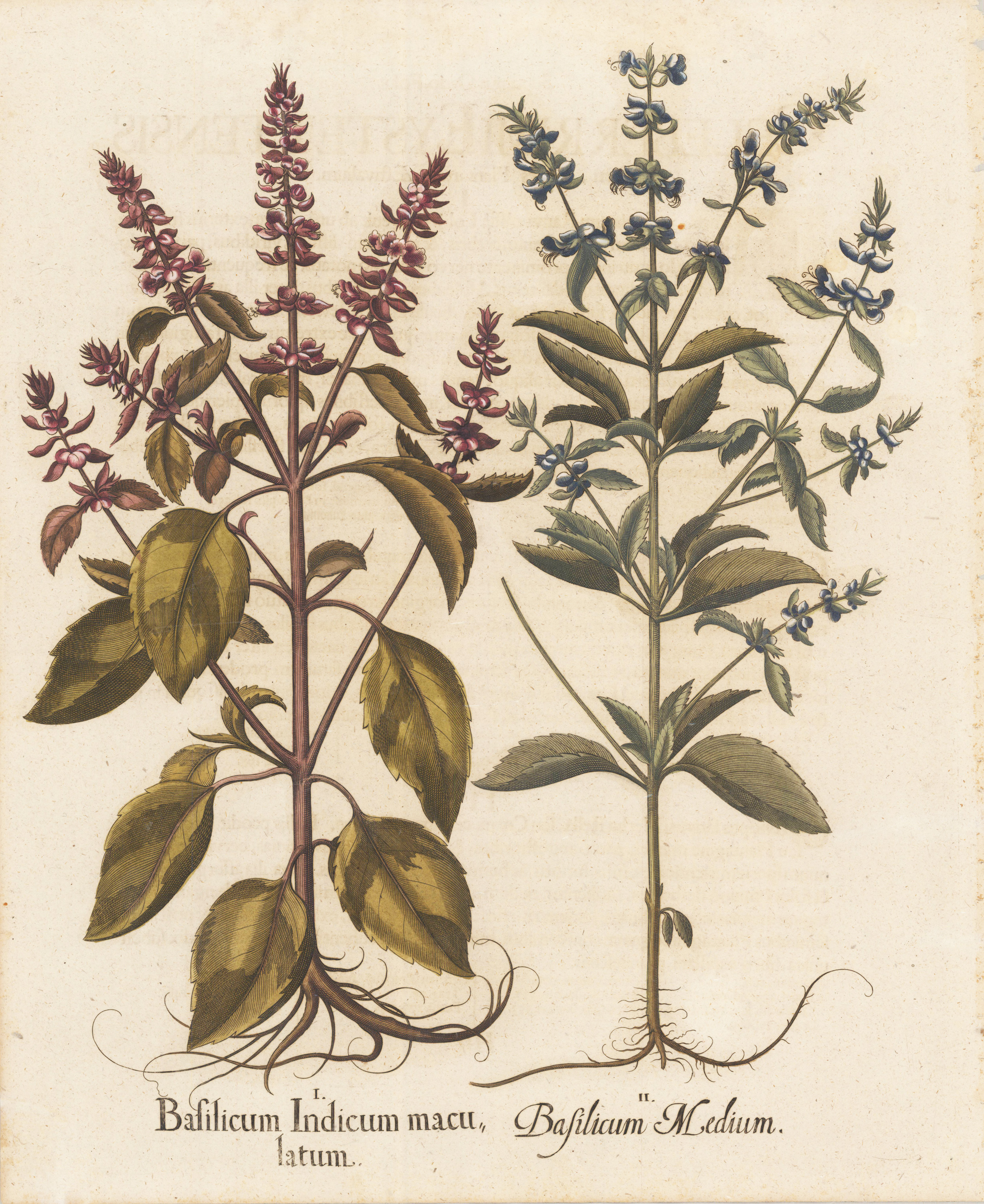
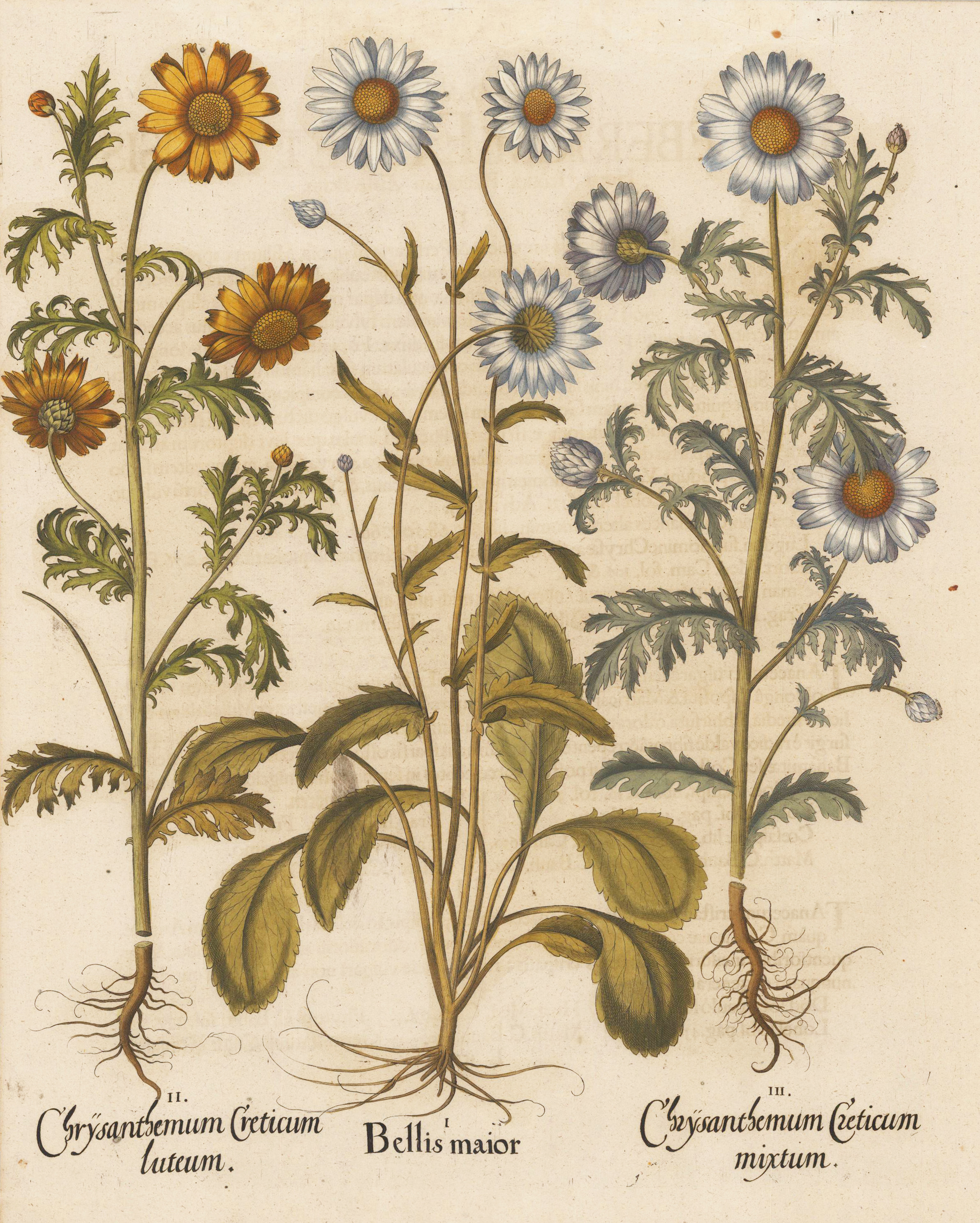
Original copper engraving, later hand colored. A fine copper engraving published in the famous large flower book,Hortus Eystettensis' in Altdorf and Nürnberg first in 1613. The,Hortus Eystettensis' was the largest flowerbook ever published in that period. It contained 367 different engraved plates, each of them depicting often with several flowers or herbs. This fine engraving was published in the so-called,jubilee edition' 1713 in Eichstätt and Nürnberg. Basilius Besler (1561–1629) was a respected Nuremberg apothecary and botanist, best known for his monumental Hortus Eystettensis. He was curator of the garden of Johann Konrad von Gemmingen, prince bishop of Eichstätt in Bavaria. The bishop was an enthusiastic botanist who derived great pleasure from his garden, which rivaled Hortus Botanicus Leiden among early European botanical gardens outside Italy. The gardens surrounded the bishop's palace, Willibaldsburg, which was built on a hill overlooking the town. These gardens had been started in 1596 and designed by Besler's colleague, Joachim Camerarius the Younger (1534–1598), a physician and botanist. Upon Camerarius' death in 1598, Besler had the remainder of Camerarius' plants moved to Eichstätt and carried on the work of planting and supervision. The bishop commissioned Besler to compile a codex of the plants growing in his garden, a task which Besler took sixteen years to complete, the bishop dying shortly before the work was published. The gardens were sacked by invading Swedish troops under Herzog Bernhard von Weimar in 1633-4; following Hortus Eystettensis they have been reconstructed and opened to the public in 1998. (Wikipedia)
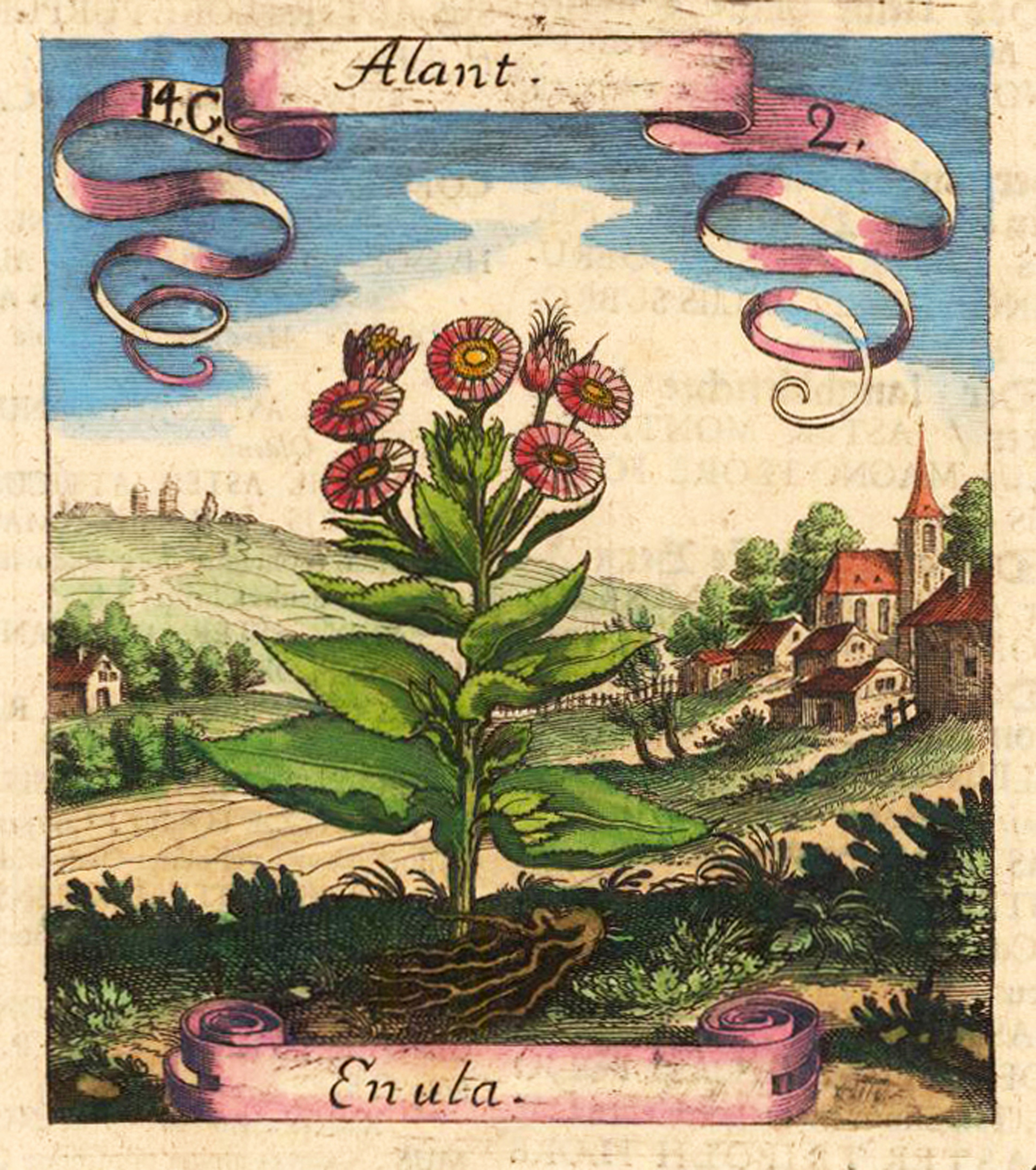
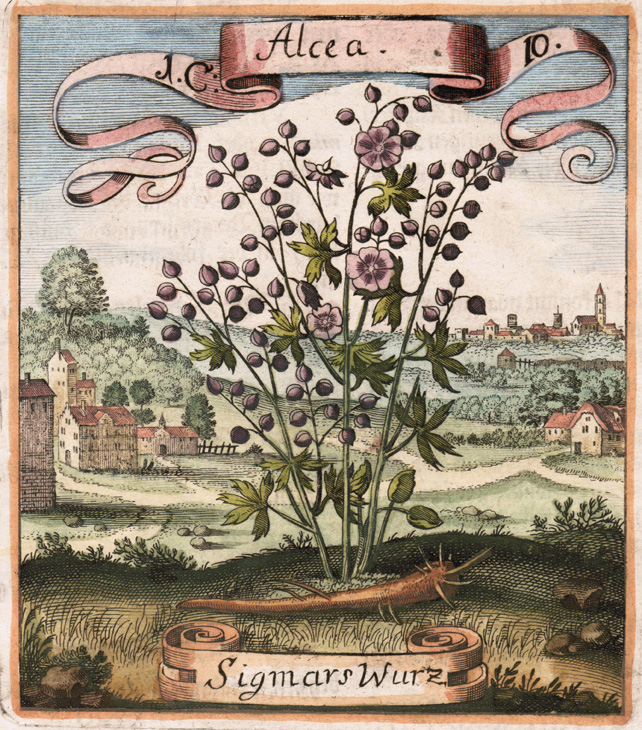
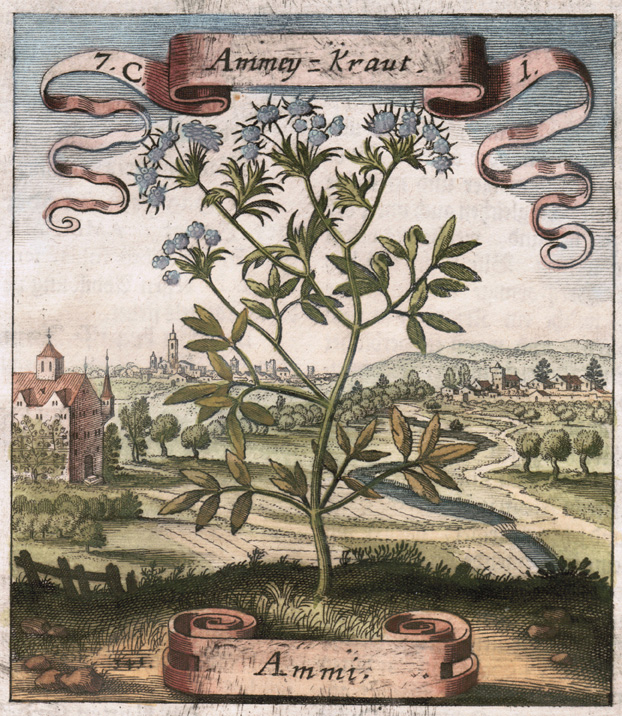
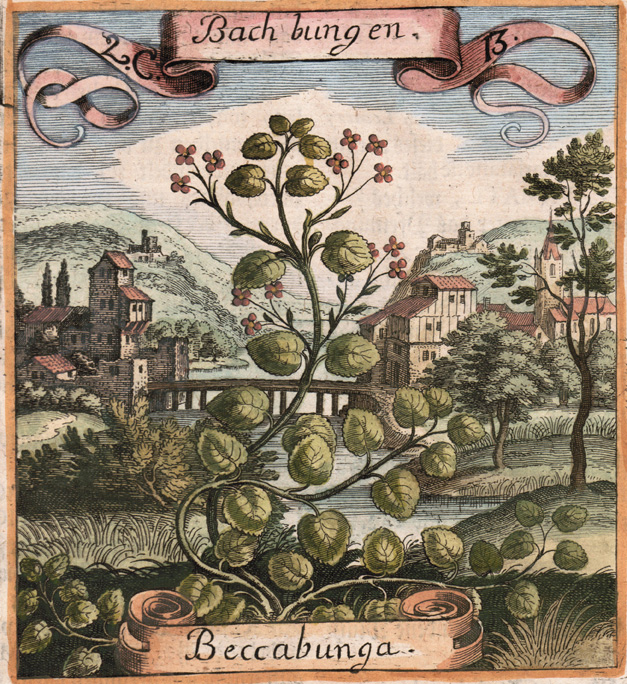
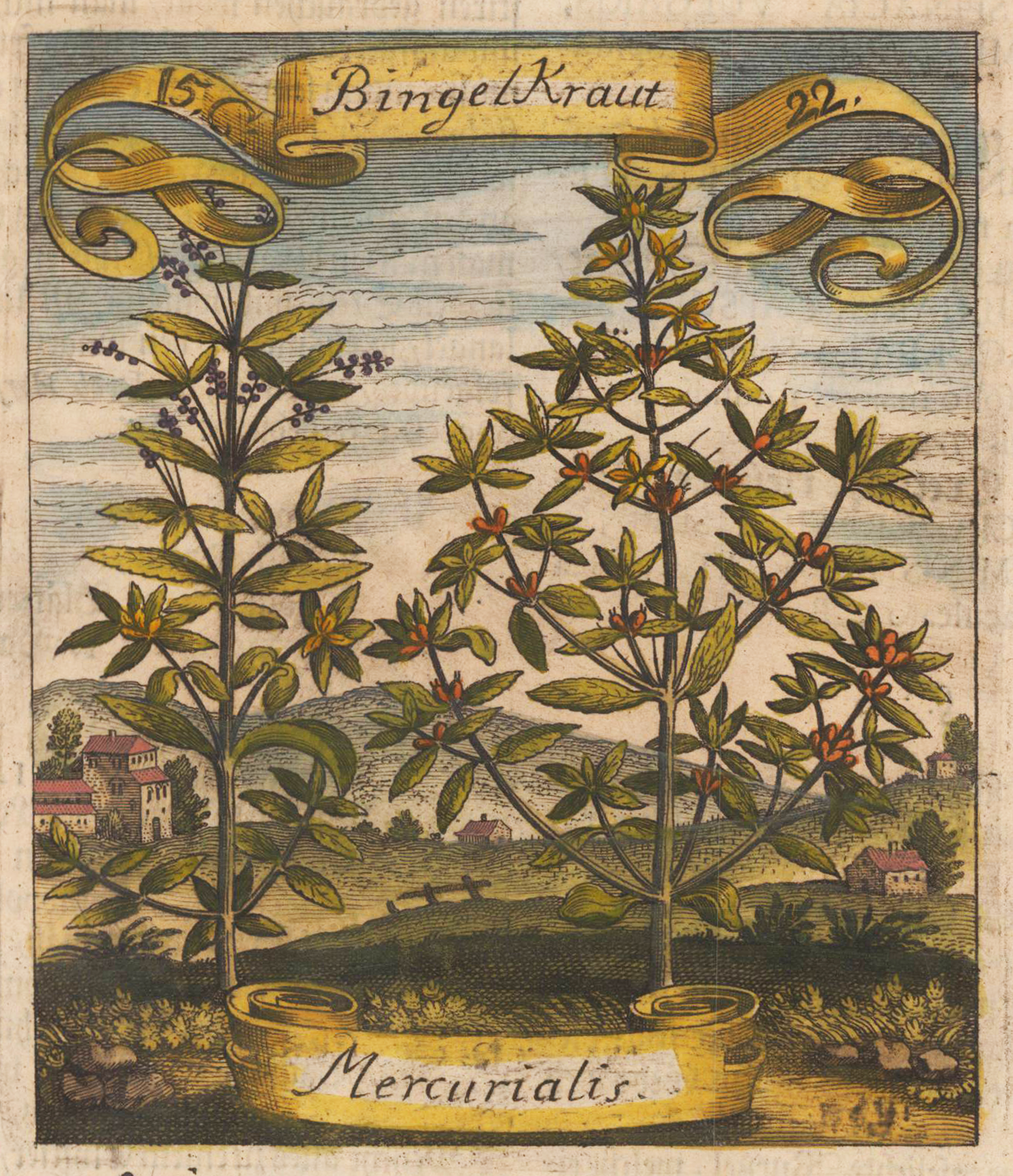
Original copper engraving, finely hand colored. This finely hand colored emblemata engraving was published 1719 in Bernhard Valentini's herbal ,Des vollständigen und Reformirten Kräuter=Buchs' at Anton Heinscheidt in Frankfurt am Main. It depicts a combination of a plant with a typical German landscape between 1650 to 1719. These allegorical emblemata engravings were composed and engraved in a very similar style as the famous allegorical illustrations, which were published by Matthaeus Merian for Ludwig Prince of Anhalt's ,Der Fruchtbringende Gesellschafft' Nahmen, Vorhaben, Gemälde und Wörter' in 1646. In this series for every of the 400 members of the ,Fruchtbringende Gesellschaft' a unique allegoric engraving was created. It seems that Bernhard Valentini either aquired from the Merian heirs inventory or from an unknown source copper plates with these allegories and used those then in his own herbal or he arranged on his own them to be created. He did this already prior with the copper plates of the flower book by de Bry, which he used in his flowerbook and which he extended then in the same style. All of these allegories are showing a combination of baroque garden scenes, landscapes, city views or castles. Each of these decorative allegories is depicting a plant specimen in front of a topographical background. This engraving is printed into a page with descriptive German text for this plant specimen.
Original antique copper engraving, hand colored. A fine copper engraving published in the famous large flower book,Hortus Eystettensis' in Altdorf and Nürnberg around 1713. The,Hortus Eystettensis' was the largest flowerbook ever published in that period. It contained 367 different engraved plates, each of them depicting often with several flowers or herbs.
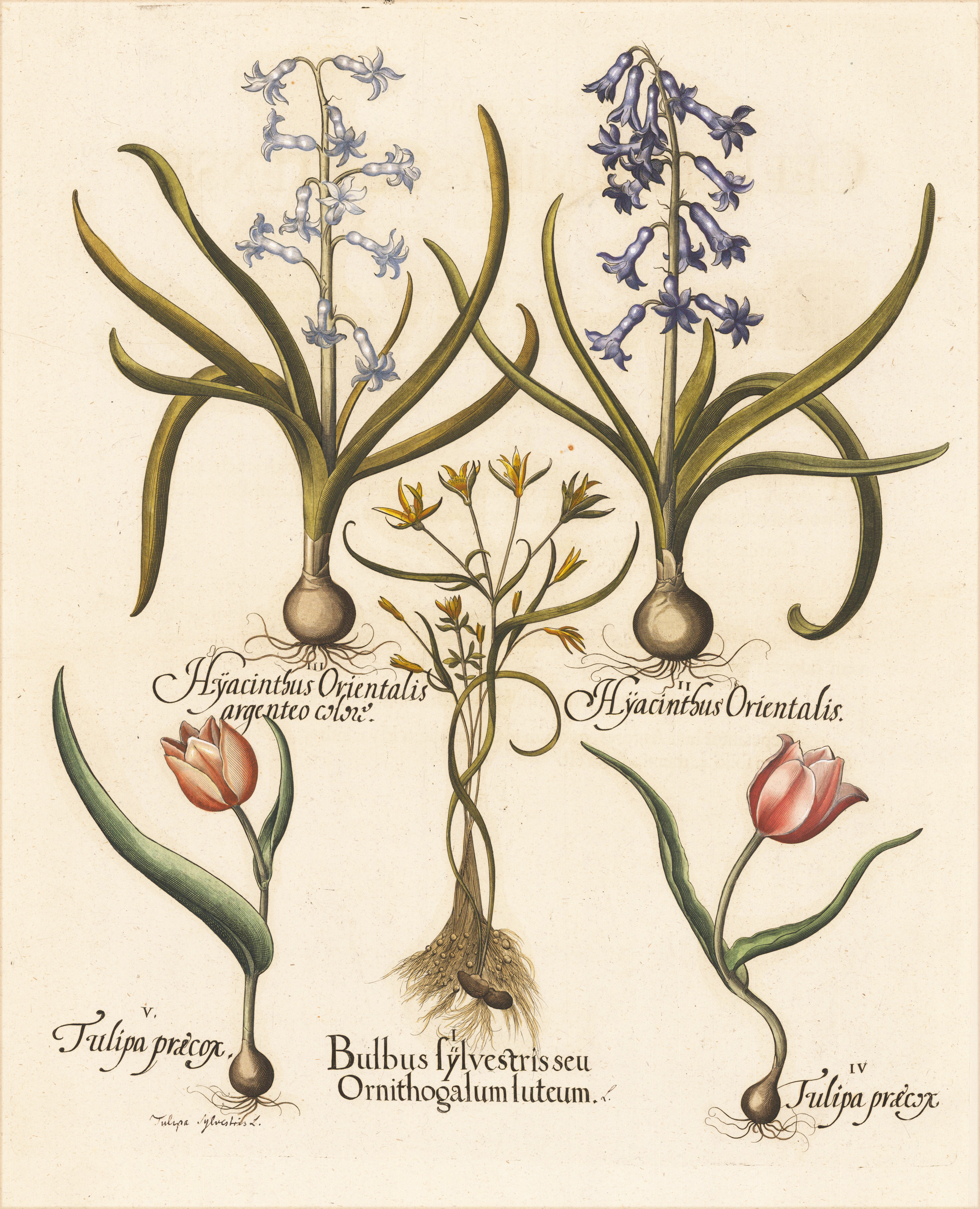
Original copper engraving. A fine hand colored copper engraving published in the famous large flower book ,Hortus Eystettensis' in Altdorf and Nürnberg first around 1613. The ,Hortus Eystettensis' was the largest flowerbook ever published in that period. It contained 367 different engraved plates, each of them depicting often with several flowers or herbs. This fine engraving is published in the so-called ,jubilee edition' 1713 in Eichstätt and Nürnberg.
Original copper engraving. A fine copper engraving published in the famous large flower book,Hortus Eystettensis' in Altdorf and Nürnberg first around 1613. The,Hortus Eystettensis' was the largest flowerbook ever published in that period. It contained 367 different engraved plates, each of them depicting often with several flowers or herbs. This fine engraving was published in the so-called,jubilee edition' 1713 in Eichstätt and Nürnberg.
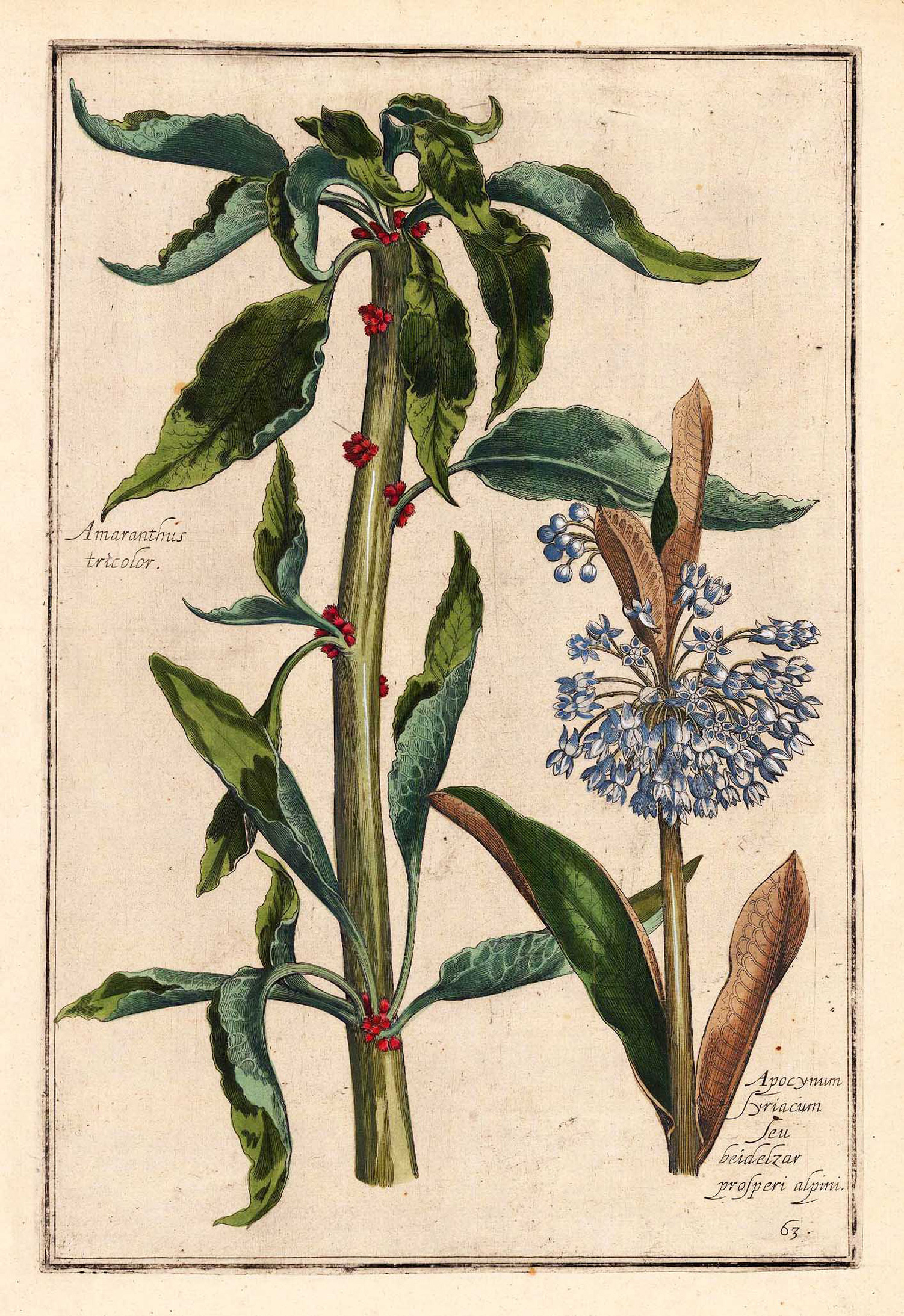
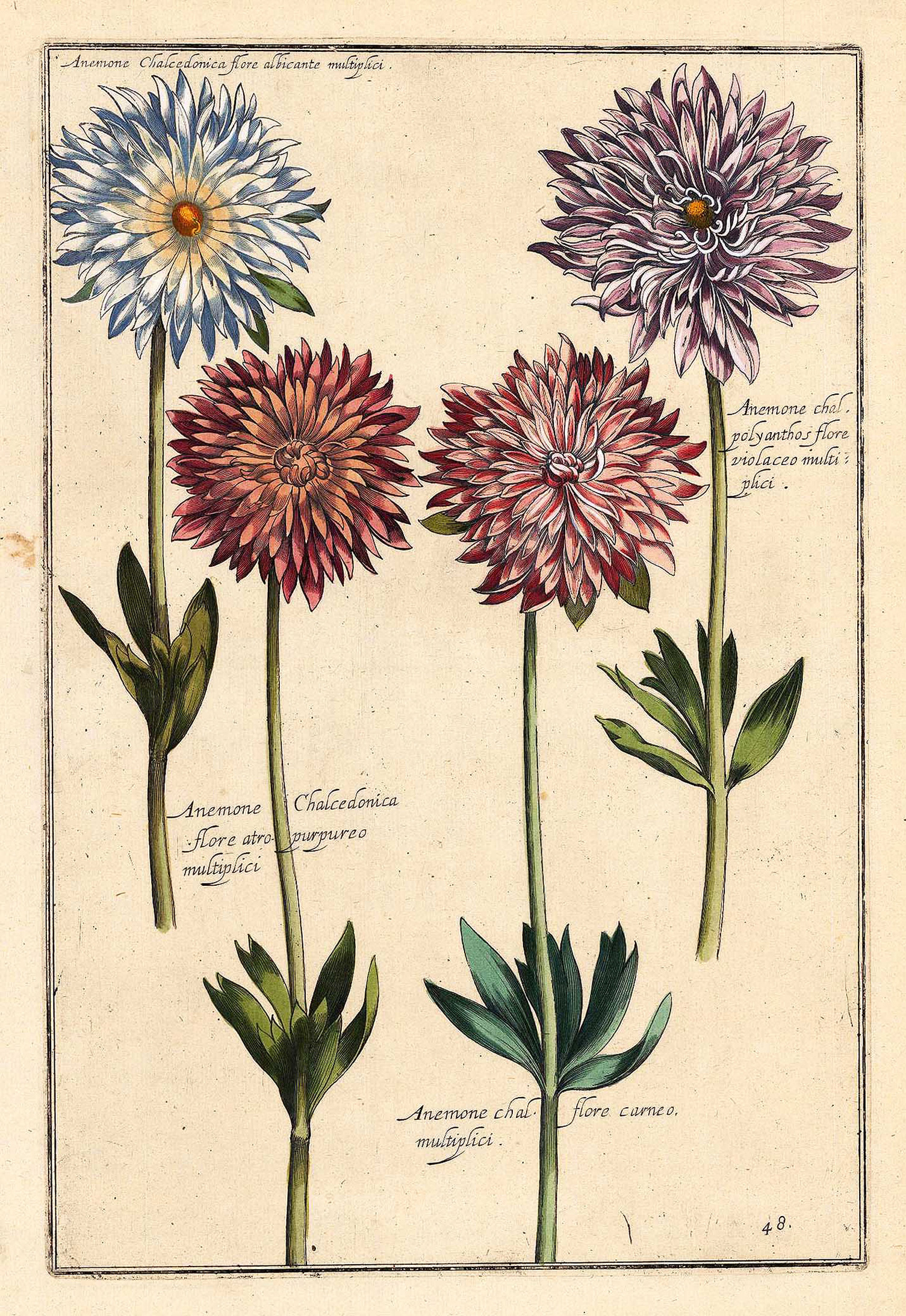
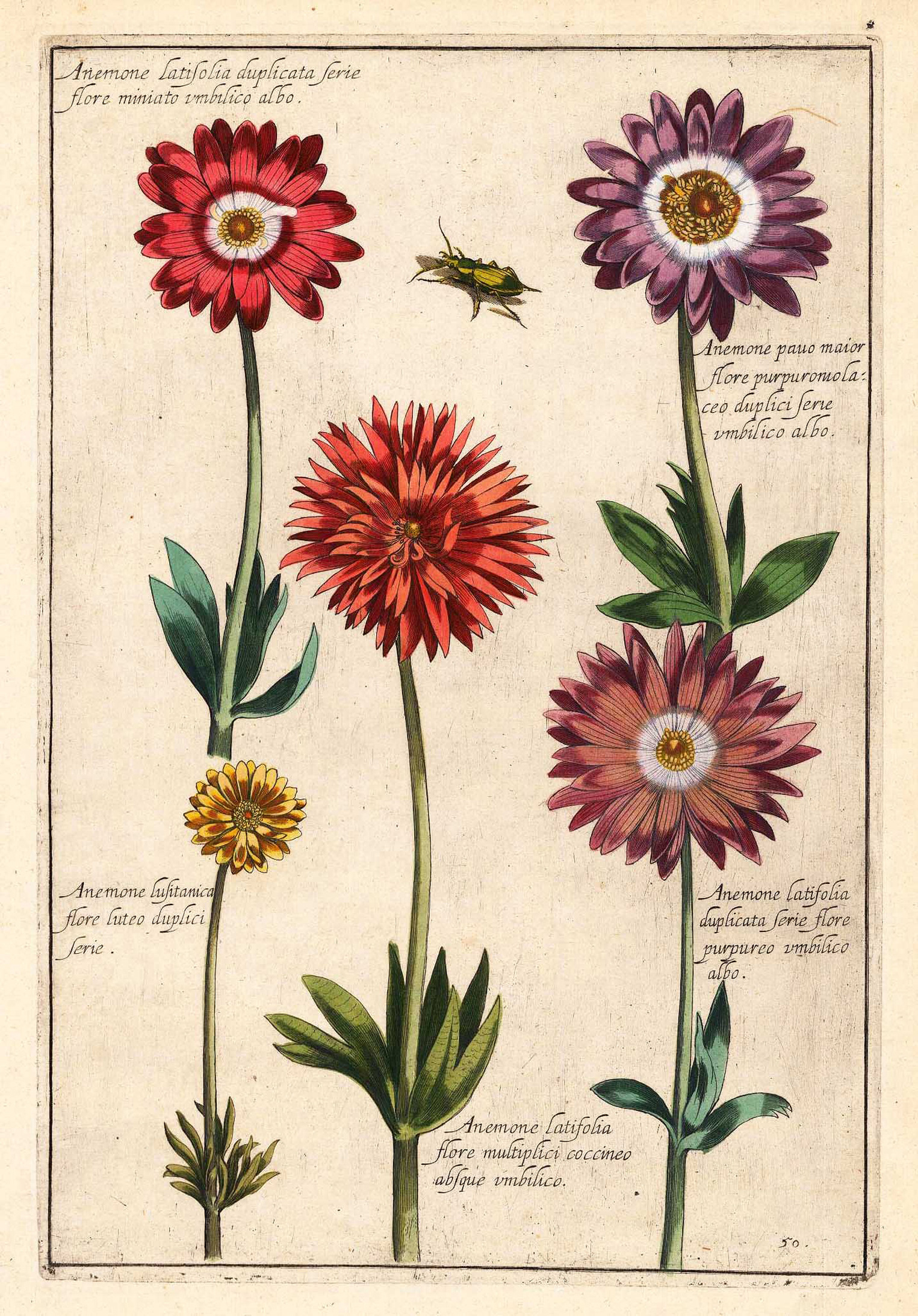
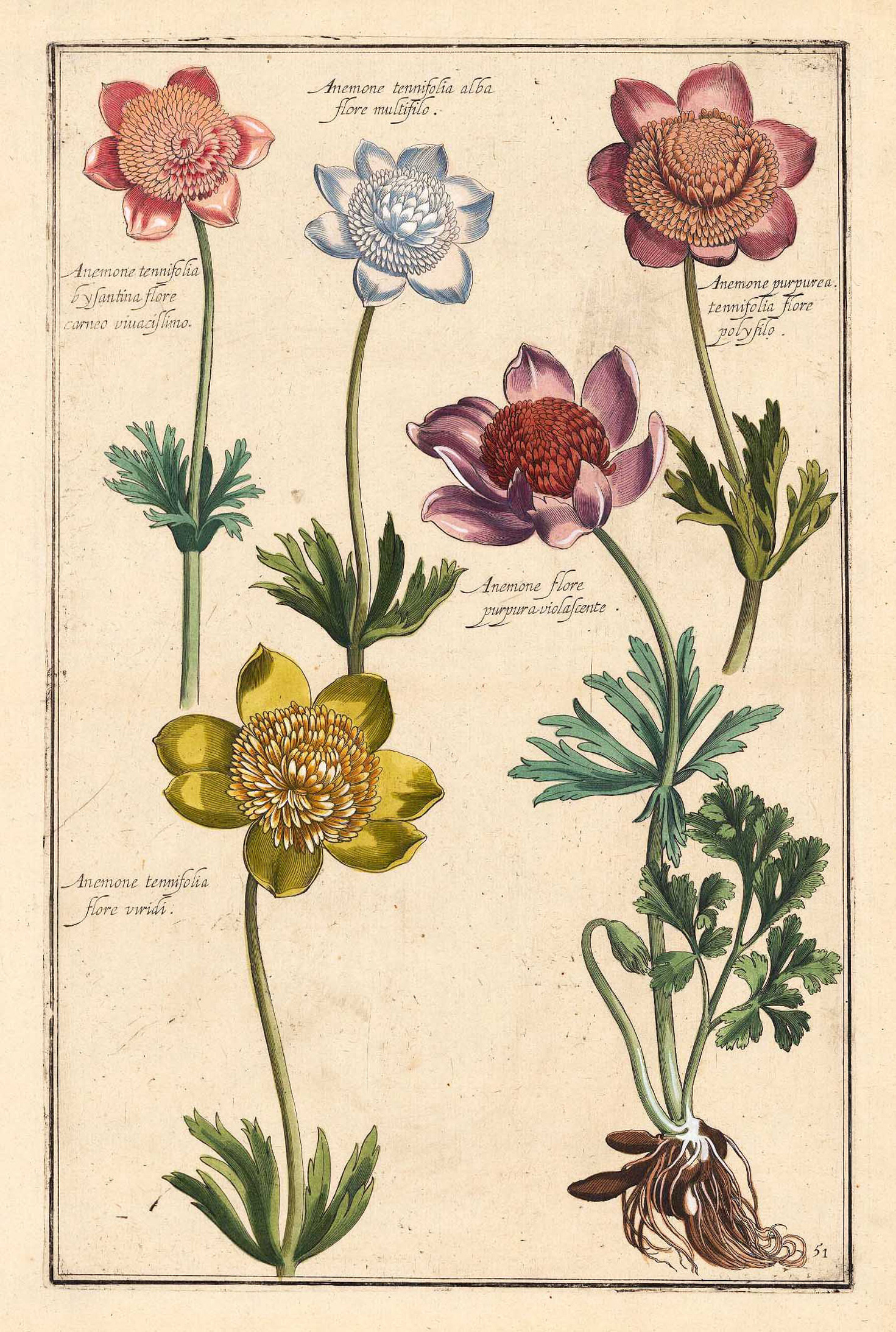
Copper engraving, later hand colored. Hand colored copper engraving, published in Paris ca. 1623-27 in the famous flower book 'Theatrum Florae'. Daniel Rabel's flower book is one of the most beautiful sets of engravings of flowers ever published. Some of these fine engraved flower prints are additional ornated with various butterflies and insects. The style of the engraving is very similar to the 'de Bry' flower plates, although Rabel's works is occasionally found to be bound to the works by Maria Sybilla Merian. The flower prints by Daniel Rabel can be regarded as one of the most beautiful and decorative sets of large engravings of flowers ever produced in that period.
Original copper engraving, finely hand colored. This finely hand colored emblemata engraving was published 1719 in Bernhard Valentini's herbal ,Des vollständigen und Reformirten Kräuter=Buchs' at Anton Heinscheidt in Frankfurt am Main. It depicts a combination of a plant with a typical German landscape between 1650 to 1719. These allegorical emblemata engravings were composed and engraved in a very similar style as the famous allegorical illustrations, which were published by Matthaeus Merian for Ludwig Prince of Anhalt's ,Der Fruchtbringende Gesellschafft' Nahmen, Vorhaben, Gemälde und Wörter' in 1646. In this series for every of the 400 members of the ,Fruchtbringende Gesellschaft' a unique allegoric engraving was created. It seems that Bernhard Valentini either aquired from the Merian heirs inventory or from an unknown source copper plates with these allegories and used those then in his own herbal or he arranged on his own them to be created. He did this already prior with the copper plates of the flower book by de Bry, which he used in his flowerbook and which he extended then in the same style. All of these allegories are showing a combination of baroque garden scenes, landscapes, city views or castles. Each of these decorative allegories is depicting a plant specimen in front of a topographical background. This engraving is printed into a page with descriptive German text for this plant specimen.
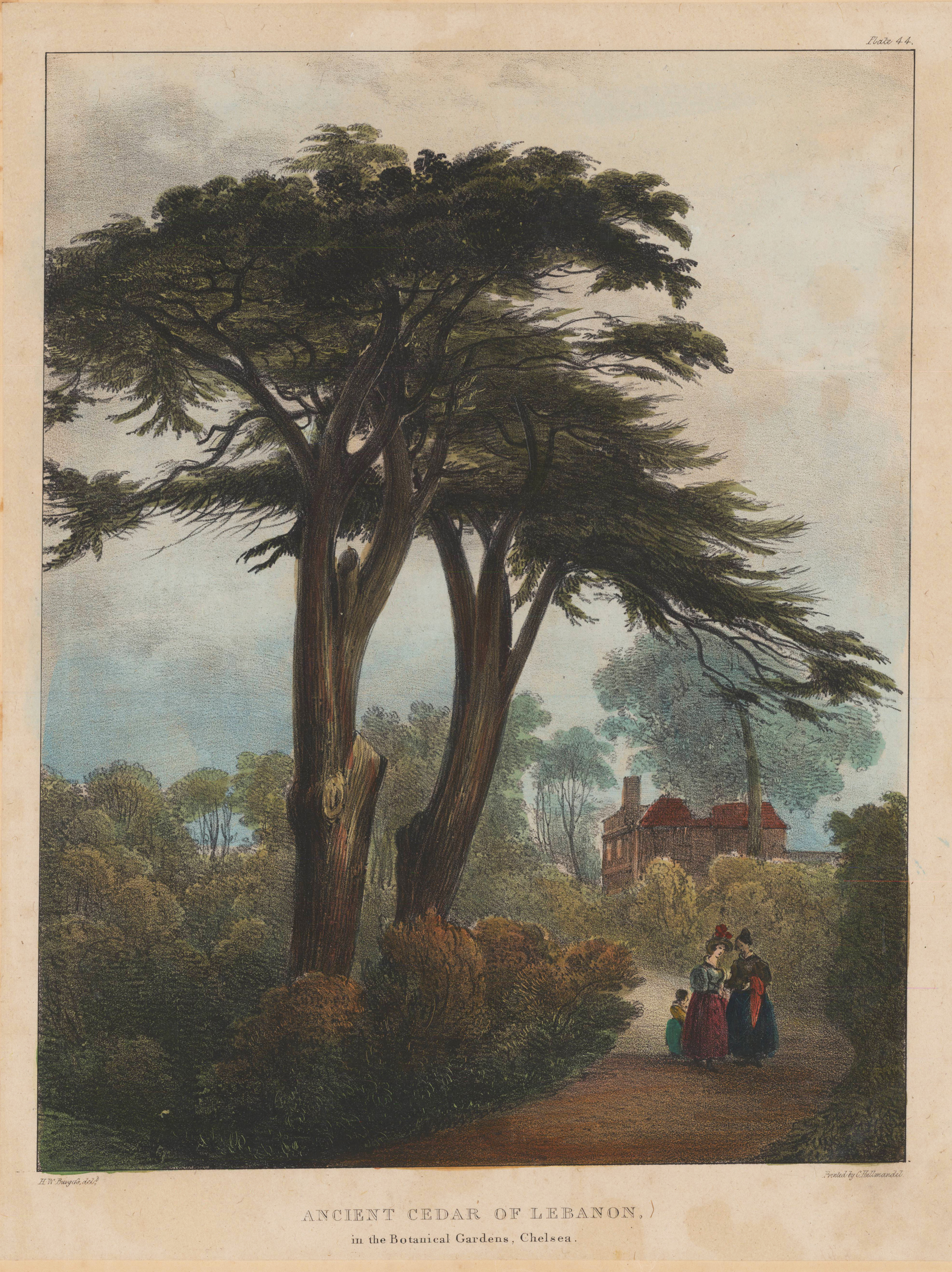
Original antique lithograph, hand colored. Decorative English landscape scene published in: Eidodendron - views of the general character and appearance of trees foreign and indigenous connected with picturesque scenery in London at J. Dickonson lithographed by Charles Joseph Hullmandel (1789-1850).
Copper engraving, later hand colored. Hand colored copper engraving, published in Paris ca. 1623-27 in the famous flower book 'Theatrum Florae'. Daniel Rabel's flower book is one of the most beautiful sets of engravings of flowers ever published. Some of these fine engraved flower prints are additional ornated with various butterflies and insects. The style of the engraving is very similar to the 'de Bry' flower plates, although Rabel's works is occasionally found to be bound to the works by Maria Sybilla Merian. The flower prints by Daniel Rabel can be regarded as one of the most beautiful and decorative sets of large engravings of flowers ever produced in that period.
Copper engraving, later hand colored. Hand colored copper engraving, published in Paris ca. 1623-27 in the famous flower book 'Theatrum Florae'. Daniel Rabel's flower book is one of the most beautiful sets of engravings of flowers ever published. Some of these fine engraved flower prints are additional ornated with various butterflies and insects. The style of the engraving is very similar to the 'de Bry' flower plates, although Rabel's works is occasionally found to be bound to the works by Maria Sybilla Merian. The flower prints by Daniel Rabel can be regarded as one of the most beautiful and decorative sets of large engravings of flowers ever produced in that period.
Copper engraving, later hand colored. Hand colored copper engraving, published in Paris ca. 1623-27 in the famous flower book 'Theatrum Florae'. Daniel Rabel's flower book is one of the most beautiful sets of engravings of flowers ever published. Some of these fine engraved flower prints are additional ornated with various butterflies and insects. The style of the engraving is very similar to the 'de Bry' flower plates, although Rabel's works is occasionally found to be bound to the works by Maria Sybilla Merian. The flower prints by Daniel Rabel can be regarded as one of the most beautiful and decorative sets of large engravings of flowers ever produced in that period.
Original copper engraving, finely hand colored. This finely hand colored emblemata engraving was published 1719 in Bernhard Valentini's herbal ,Des vollständigen und Reformirten Kräuter=Buchs' at Anton Heinscheidt in Frankfurt am Main. It depicts a combination of a plant with a typical German landscape between 1650 to 1719. These allegorical emblemata engravings were composed and engraved in a very similar style as the famous allegorical illustrations, which were published by Matthaeus Merian for Ludwig Prince of Anhalt's ,Der Fruchtbringende Gesellschafft' Nahmen, Vorhaben, Gemälde und Wörter' in 1646. In this series for every of the 400 members of the ,Fruchtbringende Gesellschaft' a unique allegoric engraving was created. It seems that Bernhard Valentini either aquired from the Merian heirs inventory or from an unknown source copper plates with these allegories and used those then in his own herbal or he arranged on his own them to be created. He did this already prior with the copper plates of the flower book by de Bry, which he used in his flowerbook and which he extended then in the same style. All of these allegories are showing a combination of baroque garden scenes, landscapes, city views or castles. Each of these decorative allegories is depicting a plant specimen in front of a topographical background. This engraving is printed into a page with descriptive German text for this plant specimen.
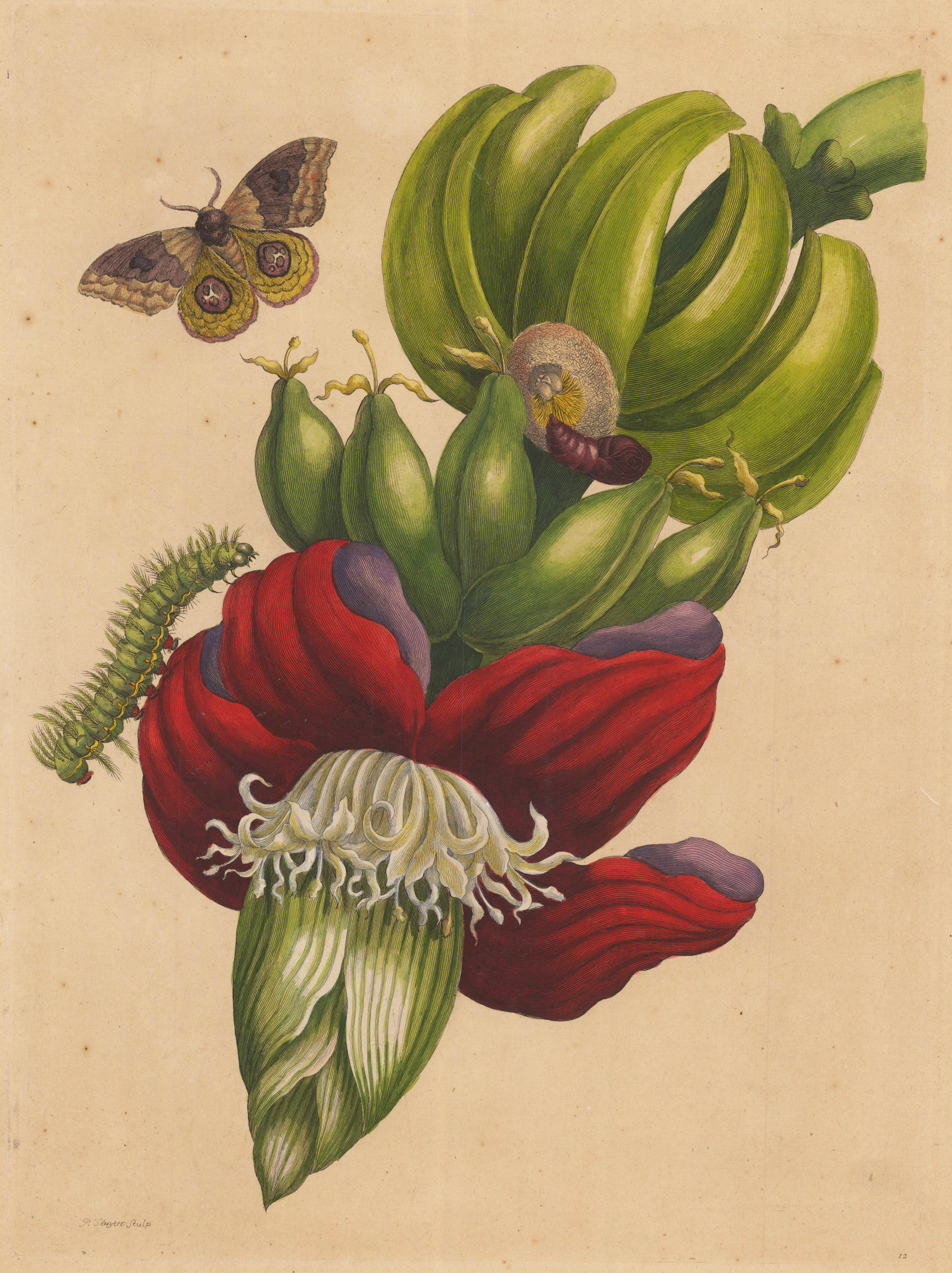
Copper engraving, finely hand colored. Finely hand colored copper engraving, published in the famous series 'Over de Voortteeling en Wonderbaerlyke veranderingen der Surinaemsche Insecten'. Maria Sibylla Merian (2 April 1647 – 13 January 1717) was a German-born naturalist and scientific illustrator, a descendant of the Frankfurt branch of the Swiss Merian family, founders of one of Europe's largest publishing houses in the 17th century. Merian received her artistic training from her stepfather, Jacob Marrel, a student of the still life painter Georg Flegel. She remained in Frankfurt until 1670, relocating subsequently to Nuremberg, Wieuwerd (1685), where she stayed in a Labadist community till 1691, and Amsterdam. Merian published her first book of natural illustrations, titled Neues Blumenbuch, in 1675 at age 28. In 1699, following eight years of painting and studying, and on the encouragement of Cornelis van Aerssen van Sommelsdijck, the then-governor of the Dutch colony of Surinam, the city of Amsterdam awarded Merian a grant to travel to South America with her daughter Dorothea. Her trip, designed as a scientific expedition makes Merian perhaps the first person to "plan a journey rooted solely in science." After two years there, malaria forced her to return to Europe. She then proceeded to publish her major work, Metamorphosis insectorum Surinamensium (de), in 1705, for which she became famous. Because of her careful observations and documentation of the metamorphosis of the butterfly, she is considered by David Attenborough to be among the most significant contributors to the field of entomology. She was a leading entomologist of her time and she discovered many new facts about insect life through her studies. (Wikipedia)
Original copper engraving in fine hand coloring. Original copper engraving. A fine copper engraving published in the famous large flower book ,Hortus Eystettensis' in Altdorf and Nürnberg around 1613. The ,Hortus Eystettensis' was the largest flowerbook ever published in that period. It contained 367 different engraved plates, each of them depicting often with several flowers or herbs.
Original copper engraving. A fine copper engraving published in the famous large flower book,Hortus Eystettensis' in Altdorf and Nürnberg around 1613. The,Hortus Eystettensis' was the largest flowerbook ever published in that period. It contained 367 different engraved plates, each of them depicting often with several flowers or herbs. This fine engraving was published in the so-called,jubilee edition' 1713 in Eichstätt and Nürnberg. Basilius Besler (1561–1629) was a respected Nuremberg apothecary and botanist, best known for his monumental Hortus Eystettensis. He was curator of the garden of Johann Konrad von Gemmingen, prince bishop of Eichstätt in Bavaria. The bishop was an enthusiastic botanist who derived great pleasure from his garden, which rivaled Hortus Botanicus Leiden among early European botanical gardens outside Italy. The gardens surrounded the bishop's palace, Willibaldsburg, which was built on a hill overlooking the town. These gardens had been started in 1596 and designed by Besler's colleague, Joachim Camerarius the Younger (1534–1598), a physician and botanist. Upon Camerarius' death in 1598, Besler had the remainder of Camerarius' plants moved to Eichstätt and carried on the work of planting and supervision. The bishop commissioned Besler to compile a codex of the plants growing in his garden, a task which Besler took sixteen years to complete, the bishop dying shortly before the work was published. The gardens were sacked by invading Swedish troops under Herzog Bernhard von Weimar in 1633-4; following Hortus Eystettensis they have been reconstructed and opened to the public in 1998. (Wikipedia)
Original copper engraving, later hand colored. A fine copper engraving published in the famous large flower book,Hortus Eystettensis' in Altdorf and Nürnberg first in 1613. The,Hortus Eystettensis' was the largest flowerbook ever published in that period. It contained 367 different engraved plates, each of them depicting often with several flowers or herbs. This fine engraving was published in the so-called,jubilee edition' 1713 in Eichstätt and Nürnberg. Basilius Besler (1561–1629) was a respected Nuremberg apothecary and botanist, best known for his monumental Hortus Eystettensis. He was curator of the garden of Johann Konrad von Gemmingen, prince bishop of Eichstätt in Bavaria. The bishop was an enthusiastic botanist who derived great pleasure from his garden, which rivaled Hortus Botanicus Leiden among early European botanical gardens outside Italy. The gardens surrounded the bishop's palace, Willibaldsburg, which was built on a hill overlooking the town. These gardens had been started in 1596 and designed by Besler's colleague, Joachim Camerarius the Younger (1534–1598), a physician and botanist. Upon Camerarius' death in 1598, Besler had the remainder of Camerarius' plants moved to Eichstätt and carried on the work of planting and supervision. The bishop commissioned Besler to compile a codex of the plants growing in his garden, a task which Besler took sixteen years to complete, the bishop dying shortly before the work was published. The gardens were sacked by invading Swedish troops under Herzog Bernhard von Weimar in 1633-4; following Hortus Eystettensis they have been reconstructed and opened to the public in 1998. (Wikipedia)
Original copper engraving, finely hand colored. This finely hand colored emblemata engraving was published 1719 in Bernhard Valentini's herbal,Des vollständigen und Reformirten Kräuter=Buchs' at Anton Heinscheidt in Frankfurt am Main. It depicts a combination of a plant with a typical German landscape between 1650 to 1719.
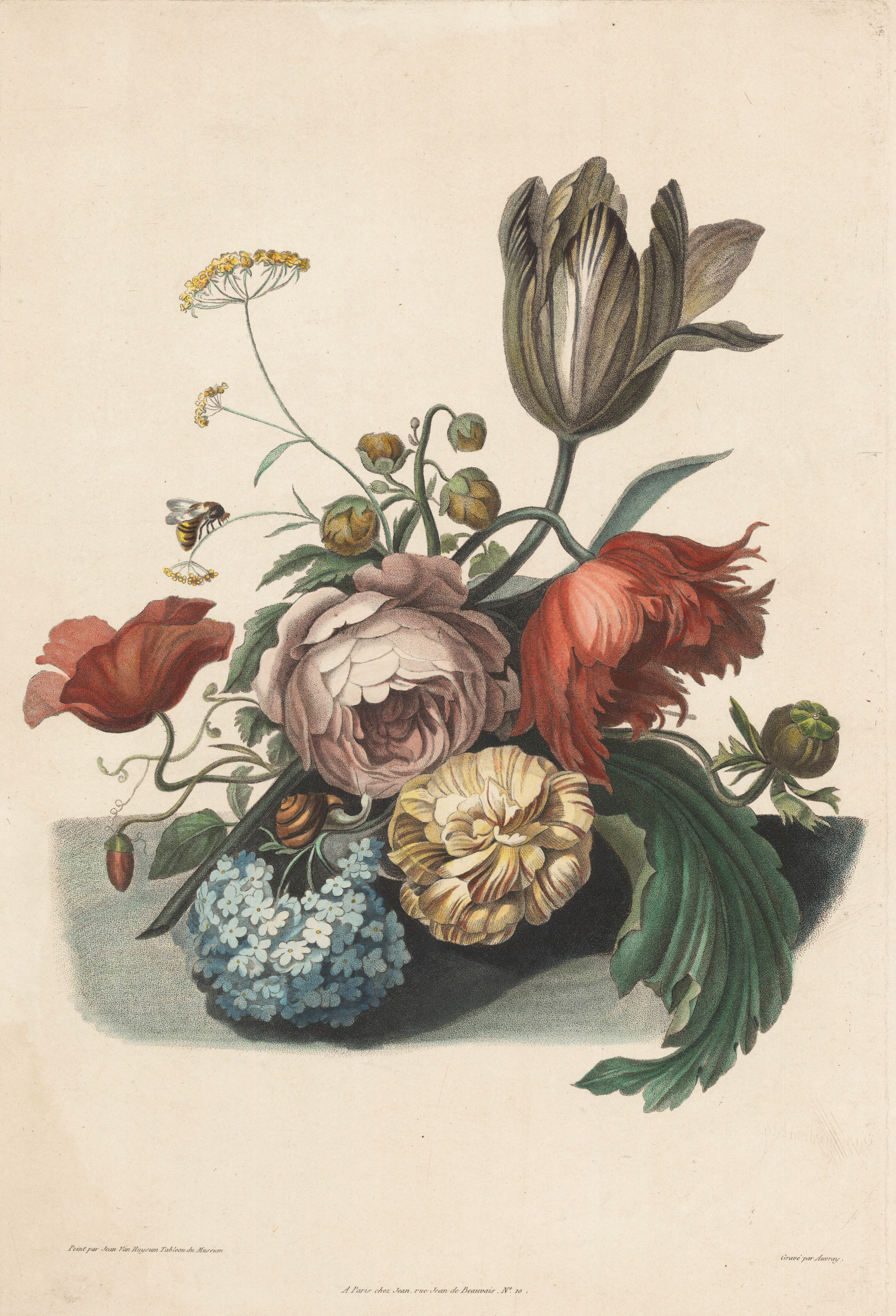
Original antique Crayon manner, finely hand colored. After a painting by Jean van Huisum. Beautiful bouquet of flowers with tulips, poppies, ranunculus, hydrangea and a few others (including a small snail and a bee).
Original copper engraving, hand colored. A fine copper engraving published in the famous large flower book ,Hortus Eystettensis' in Altdorf and Nürnberg first around 1613. The ,Hortus Eystettensis' was the largest flowerbook ever published in that period. It contained 367 different engraved plates, each of them depicting often with several flowers or herbs. Platenumber: 122 This fine engraving is published in the so-called ,jubilee edition' 1713 in Eichstätt and Nürnberg.
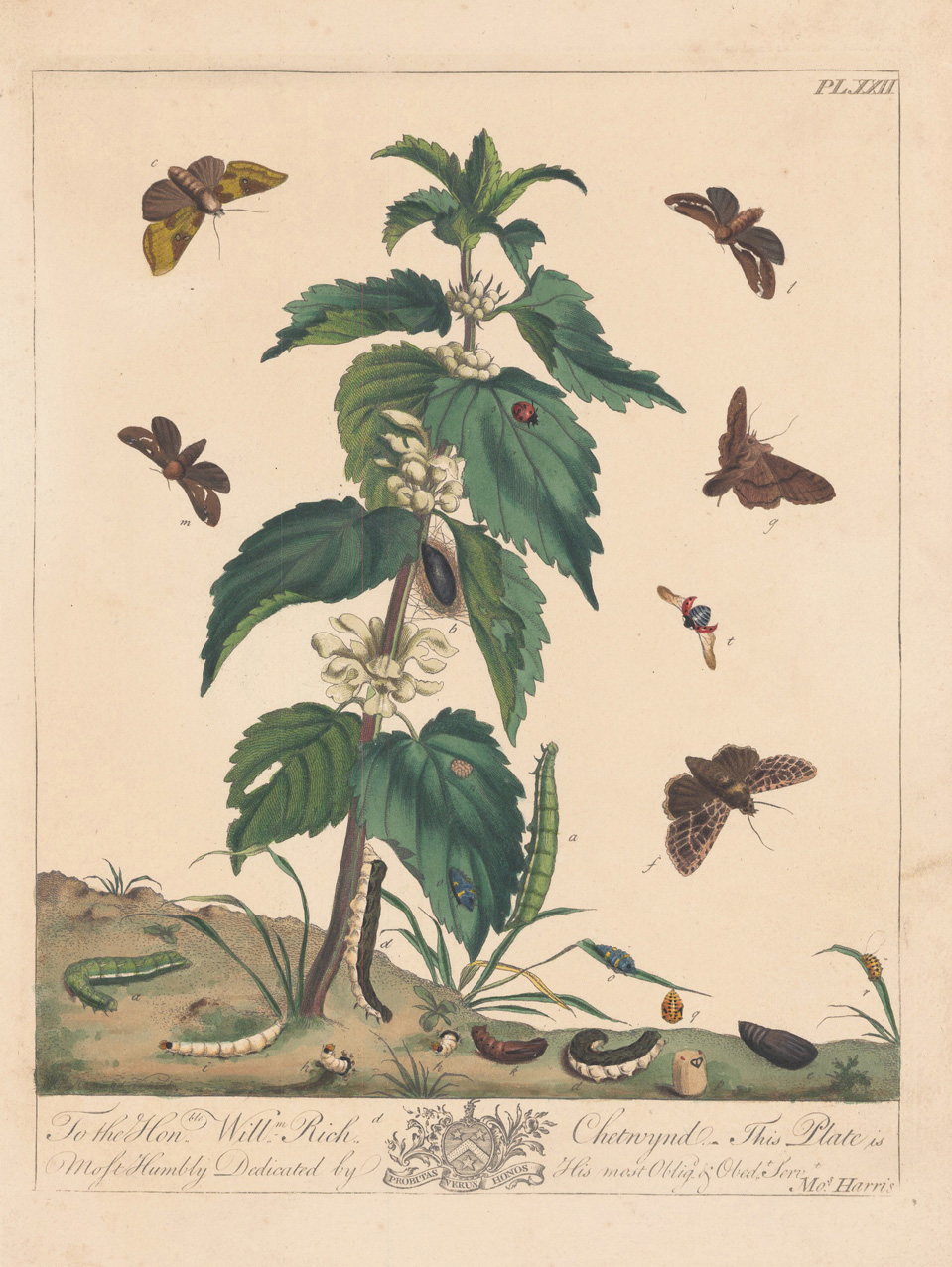
Original copper engraving, finely hand colored when published. Fine hand colored copper engraving published in Moses Harris ,Aurelian', London at Henry G. Bohn 1840. The Bohn edition is well known for its fine coloring and its excellent paper quality. „Harris was encouraged in entomology from a young age by his uncle, a member of the Society of the Aurelians. In 1762 he became secretary of a second Society of Aurelians. He was a skilled artist, displaying some of his insect drawings at the Royal Academy in 1785. He drew and engraved illustrations for books including Dru Drury's Illustrations of Natural History (3 volumes, 1770–1782) and John Coakley Lettsom's The Naturalist's and Traveller's Companion (1772)." (Wikipedia)

![[still life with flowers]](https://bergbook-sw6.1drop.dev/media/37/4a/9e/1713264922/18019.jpg "18019")