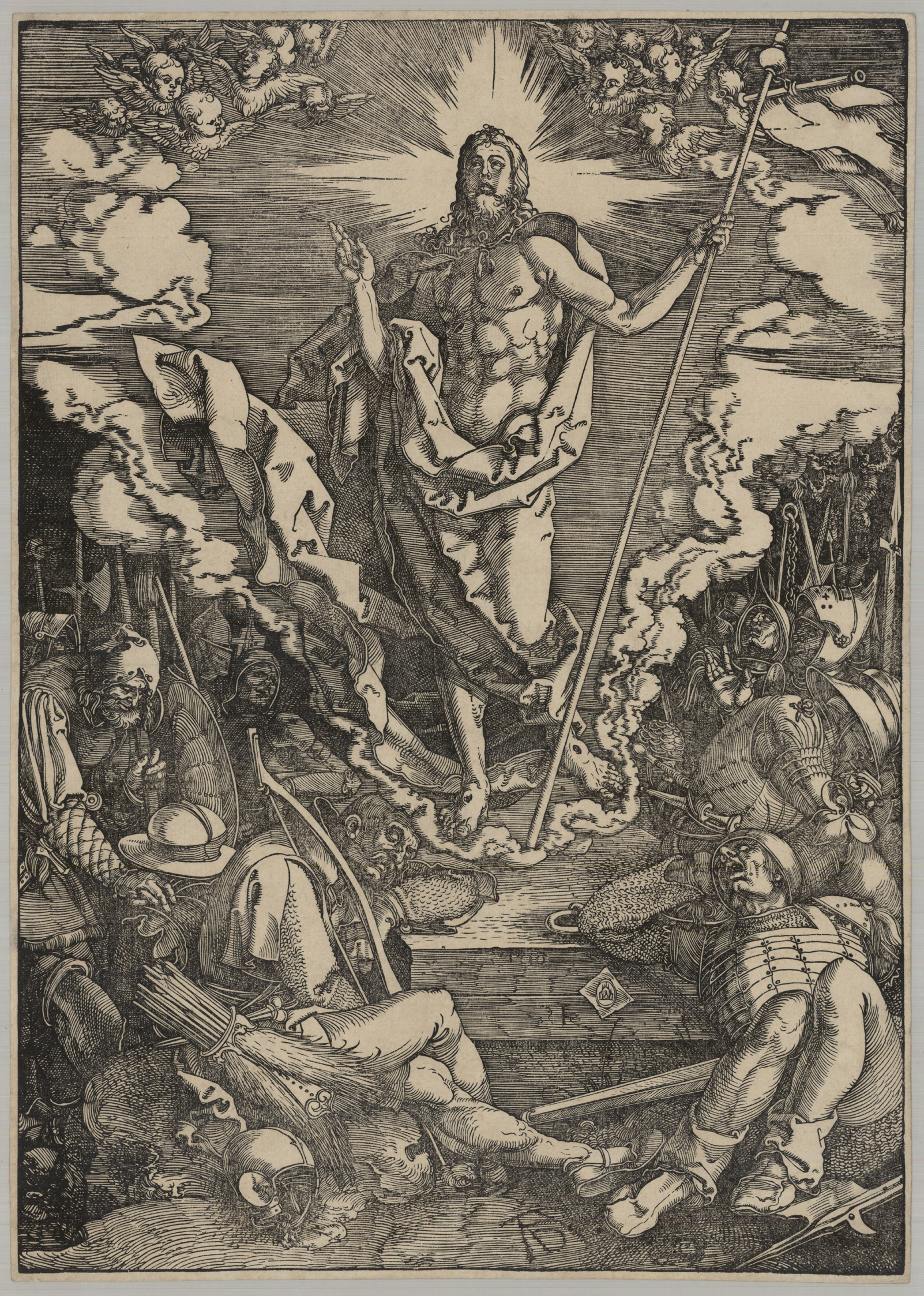
Original woodcut, with monogram and date 1510, verso no text. An overall clear and strong impression, with the gap in the cross ransom (Meder 124b) and before the scratch in left armpit of Christ and before the wormhole in the coat of Christ (at the right knee). Partial visible water mark „Namen Jesu", Meder no. 306. The „resurrection of Christ" is the last woodcut from Albrecht Dürer's series of the ,large passion'. The large passion is one one of the main works of Albrecht Dürer. In the foreground, the soldiers who are supposed to guard the tomb of Christ fell asleep. Christ appears above them in an aureole of clouds clothed only in a cloak, giving the cross-staff in the left hand and with the right the blessing. The head of Christ is surrounded by a nimbus and the whole upper edge of the picture is filled with angels.
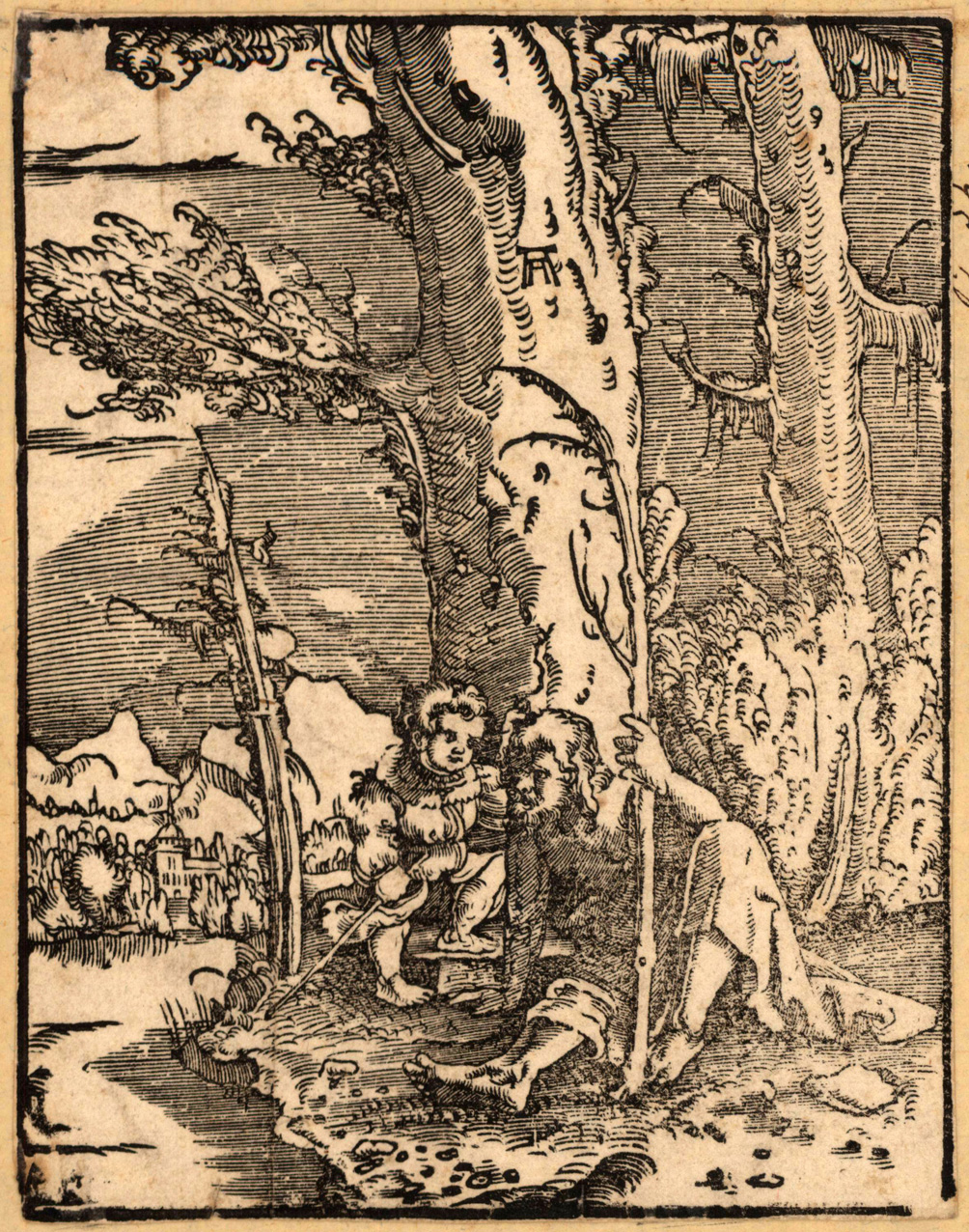
Original woodcut c. 1515-17. The woodcut shows Saint Christopher sitting on the ground to make it easier for the child Jesus, who is holding on to his mop of hair, to mount his shoulders. Rare representation of this quite rare original woodcut by Altdorfer.
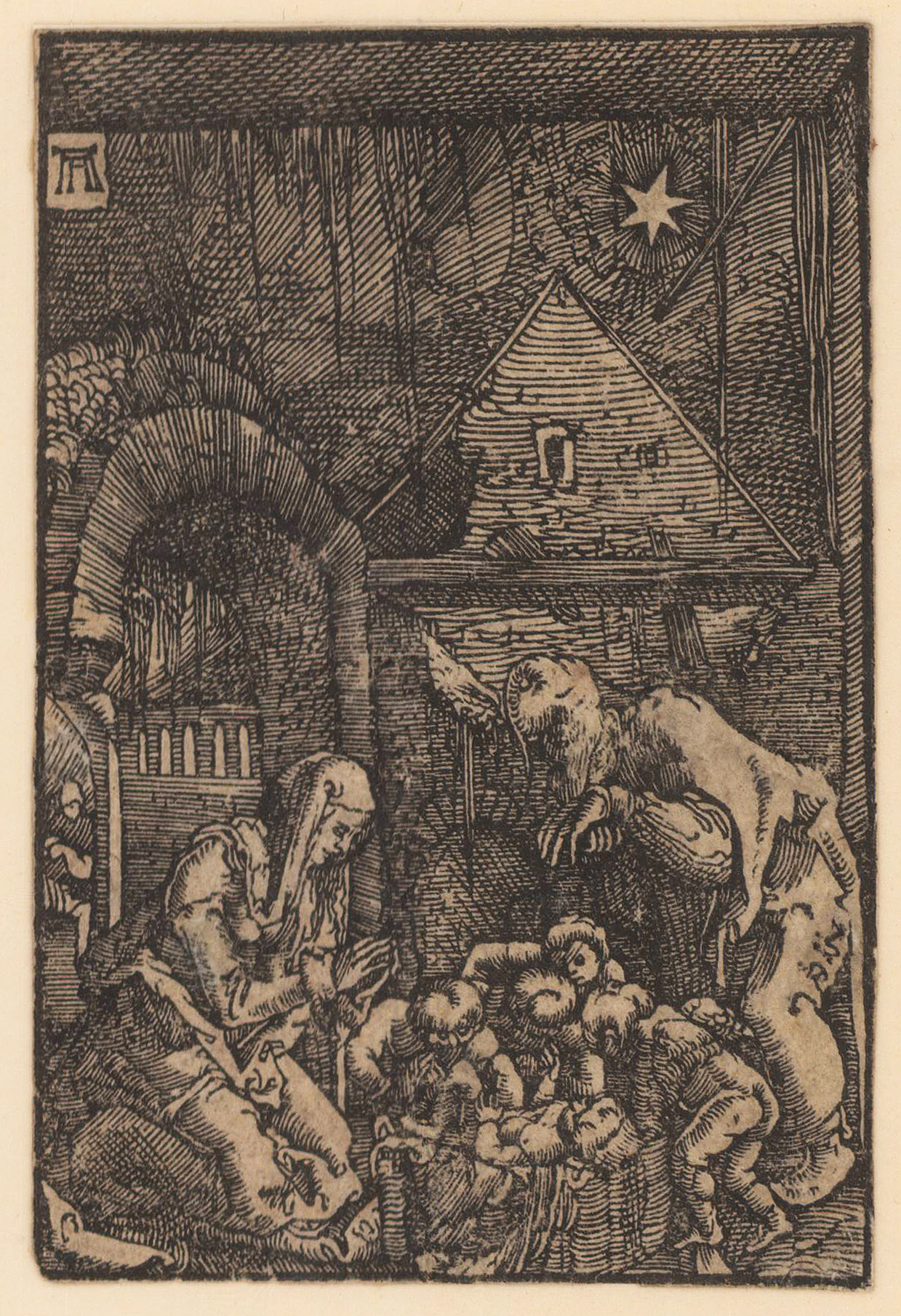
Original woodcut, printed and published 1513 in Regensburg. A fine, clear and dark impression of Albrecht Altdorfer's „The Nativity", printed and published in his series of fourty woodcuts,the fall and redemption of man'. An excellent impression with great clarity in detail and depth in the background. The 'Birth of Christ' is one of the most beautiful representations of Albrecht Altdorfer's work.
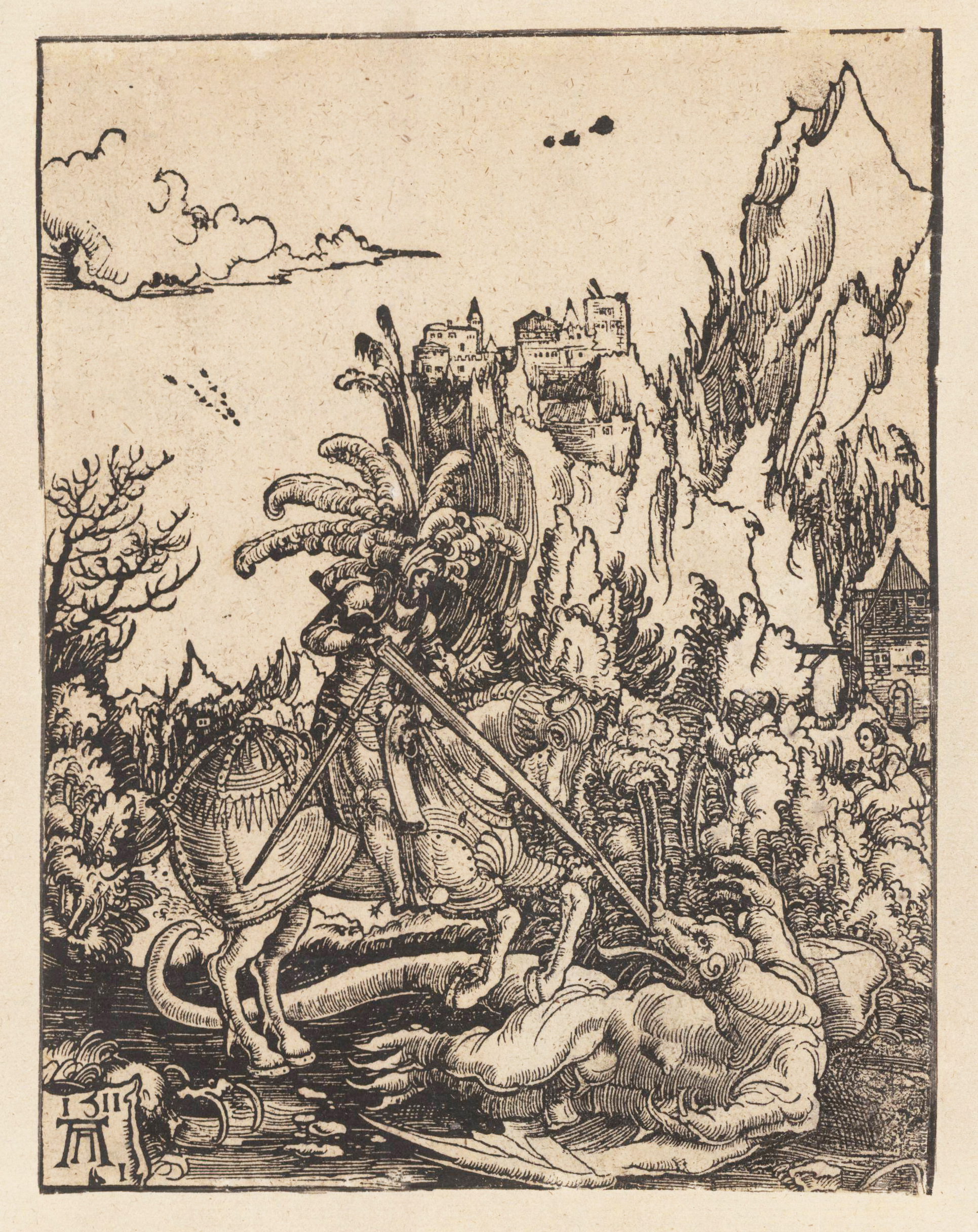
Original antique woodcut. This is Albrecht Altdorfer's first large woodcut dated 1511. It shows the dragon fight of St. Georg in front of a steep mountain backdrop. The princess has taken refuge behind a bush, where she prays for a happy outcome to the fight. The horse and rider are clearly highlighted, the dragon - large and hideous - writhes on the bare earth, already mortally wounded by the knight's lance. The burnt earth around him and the bones he left behind from his victims testify to his danger. The castle and town in the background indicate the places threatened by the monster; The rescue operation is not least for their protection. The traditionally designed woodcut shows the knight as the savior of the virgin and liberator of the country, which had to satisfy the monster's appetite with ever new sacrifices. Very good, dark impression of this rare woodcut with the broken edge at the top right and the additional 10 mm gap at the highest point of the cloud, as asked by Winzinger for the third state. Woodcut border line partially slightly trimmed, therefore the woodcut was skillfull remargined with old paper by the prior owner. Overall this rare woodcut is in good to very good condition. There are according to Winzinger only 15 impressions in private collections. The paper bears chainlines (distance ca. 23 mm) and a difficult identifiable watermark in the centre (probable a small shield).
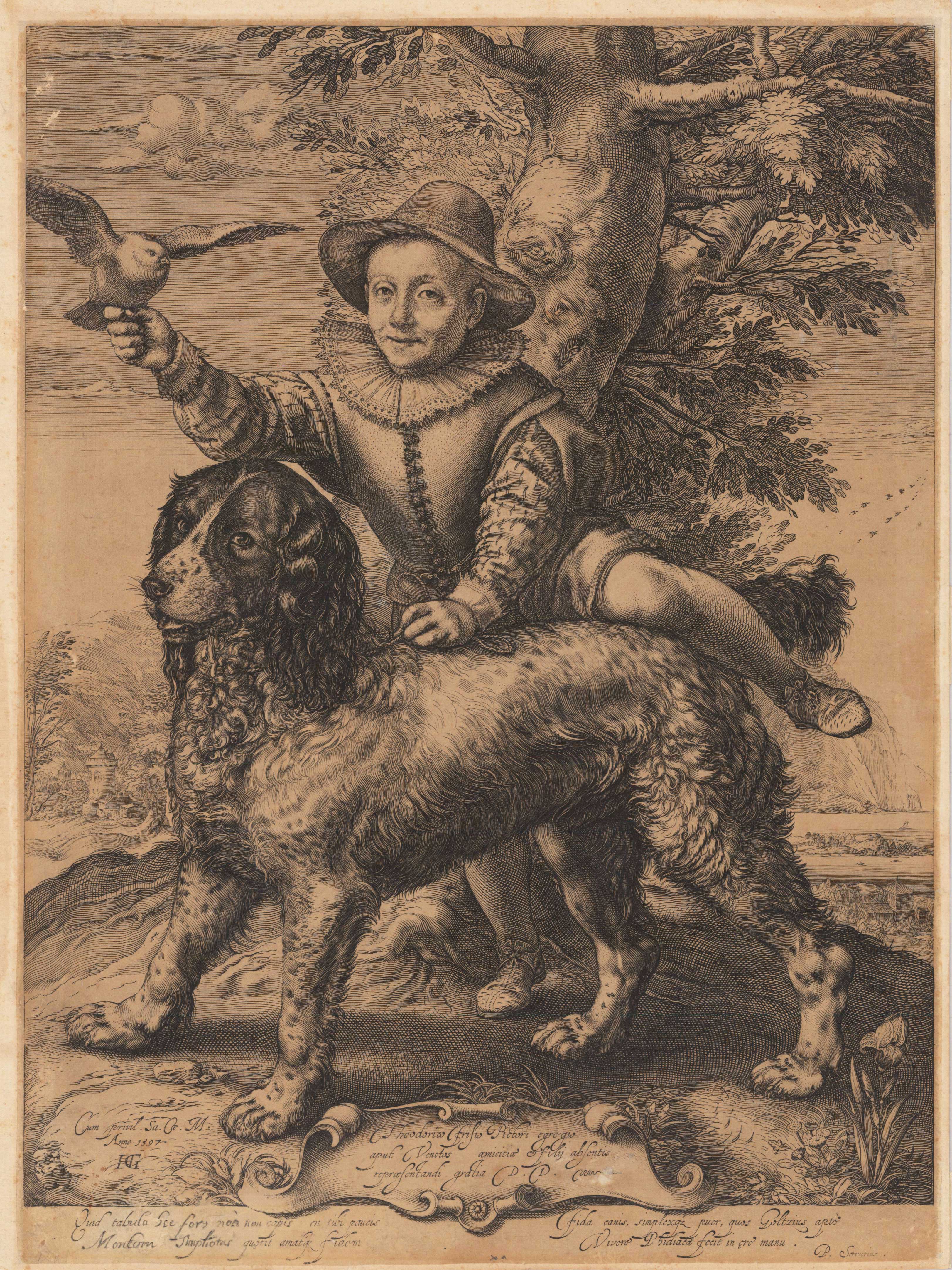
Copper engraving, on laid paper, with watermark (see illustration). A fine copper engraving by the famous Dutch engraver Hendrick Goltzius (1558-1617). The portrait depicts the young boy ,Frederick de Viries' the son of the painter Dirck de Vries from Venice, who was a close friend of Hendrick Goltzius.
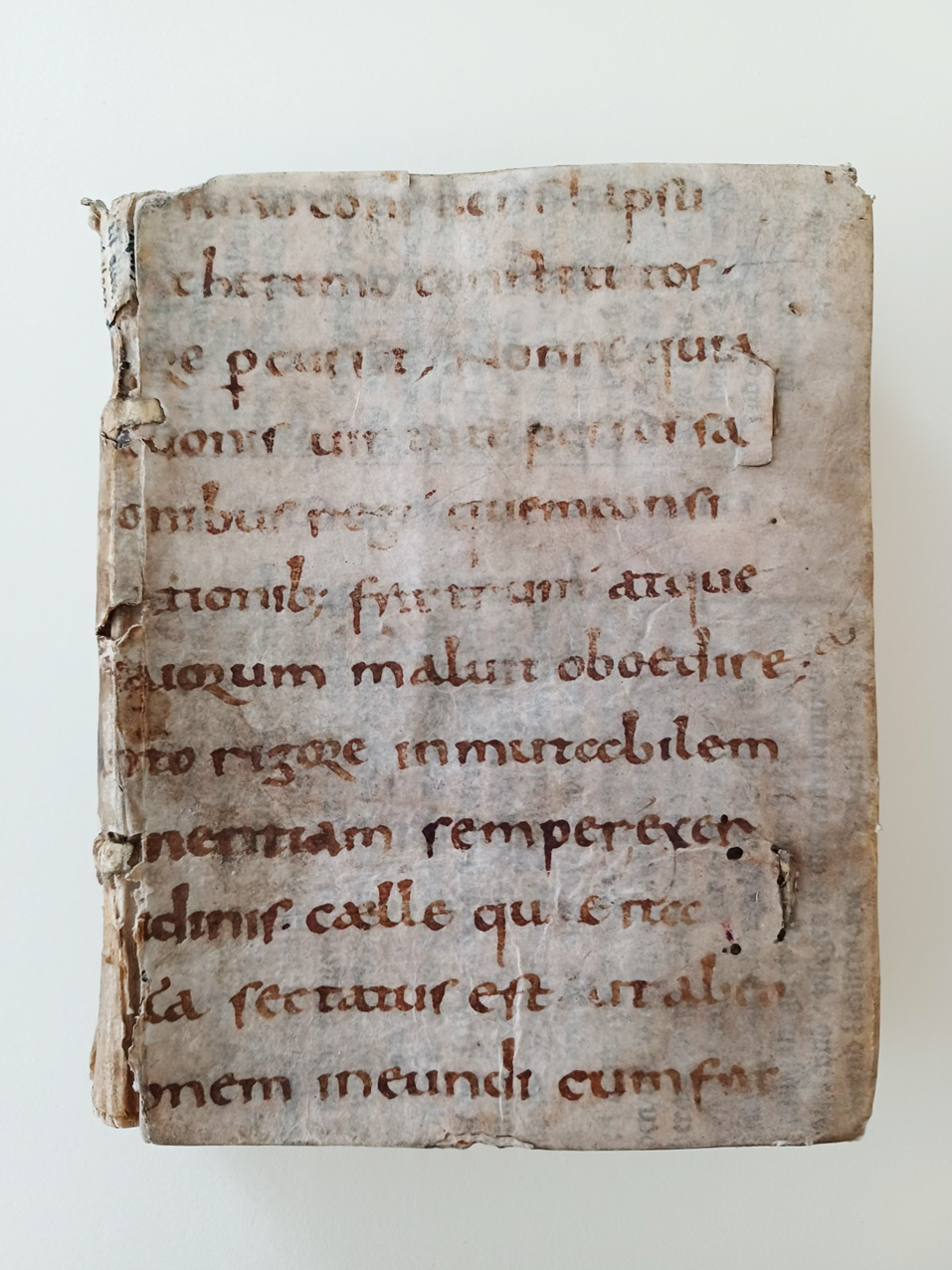
8vo. Title printed in red and black with large initial,H' in red. The,Hortolus anime illustrated weith a total of 75 woodcut illustrations by the swiss artist Urs Graf (1485-1527) and the German artist Hans Baldung Grien (1484-1545). Vellum binding of the period with manuscrript, lacking the ribbons, spine worn and with abrasions and losses. Complete with all 75 woodcut illustrations, however lacking the last numbered page (16) of the first part of the book. The woodcuts overall in good impressions, text partially cut through the binding. 15 (16) num. Bll., 97 numm. Bll., 1 unnm. Bl. Illustrated with 1 large fullpage woodcut,beate Mariae viginis', 73 small woodcuts in text and one fullpage printer's device woodcut at the last unnumbered leaf. Hans Baldung (* 1484 or 1485 in Schwäbisch Gmünd; † September 1545 in Strasbourg), also called Hans Baldung Grien after his favorite color green, was a German painter, draftsman and engraver at the time of Albrecht Dürer, who also made numerous designs for woodcuts and made stained glass. He is one of the outstanding artists of the Renaissance in German-speaking countries. In 1503, Hans Baldung went to Nuremberg to continue his studies under Albrecht Dürer. Here he was given the nickname "Grien", according to legend "the Green", because he liked to wear green clothing and generally preferred the green color; in this way they wanted to distinguish him from the other journeymen in the workshop with the names Hans, Hans Schäufelein and Hans Süss von Kulmbach. He became Dürer's most important employee and ran his workshop during Dürer's absence. In the spring of 1509, Baldung returned to Strasbourg and acquired citizenship there. In 1510 he was accepted as a master craftsman by the "zur Steltz" guild and opened his own workshop. He achieved high social standing and prosperity in Strasbourg. From 1533 to 1534 he held the office of alderman in his guild and in 1545, the year of his death, even became a councilman. Urs Graf (c. 1485 in Solothurn, Switzerland – possibly before 13 October 1528) was a Swiss Renaissance goldsmith, painter and printmaker (of woodcuts, etchings and engravings), as well as a Swiss mercenary. He only produced two etchings, one of which dates from 1513 – the earliest known etching for which a date has been established. However, his woodcuts are considered of greater significance, particularly as he is attributed with the invention of the white-line woodcut technique, where white lines create the image on a black background. He also produced a few engravings, including copies of works by Martin Schongauer and Albrecht Dürer. He produced innovative drawings intended as finished works of art rather than just studies. Graf learned goldsmithing first from his father, Hugo Graf, then from a goldsmith in Zürich. He continued to work as a goldsmith and a few pieces survive. He initially earned money as a designer of woodcut book illustrations and by assisting a stained glass painter. In 1512, he bought citizenship in Basel and became a member of the goldsmiths' guild. He quickly came into conflict with the law for abusing his wife and consorting with prostitutes, culminating in accusations of attempted murder which caused him to flee the city in 1518. He was allowed to return to Basel the following year, where he continued working, but after 1527 his life becomes unclear. Given his frequent employment as a soldier of fortune it is possible he was present at the sack of Rome. Christiane Andersson noted that, "When and where he died are unknown: his wife remarried in October 1528 but an autograph drawing is dated 1529". Like many Swiss men of his day, Graf was known to have worked as a mercenary for considerable periods. His artistic output, arising from the tradition of Albrecht Dürer and Hans Baldung, includes a wide range of subjects, depicting social, erotic, military, political, and criminal images (e.g., Two Prostitutes Beating a Monk), as well as strong religious feelings which emerge in some works.
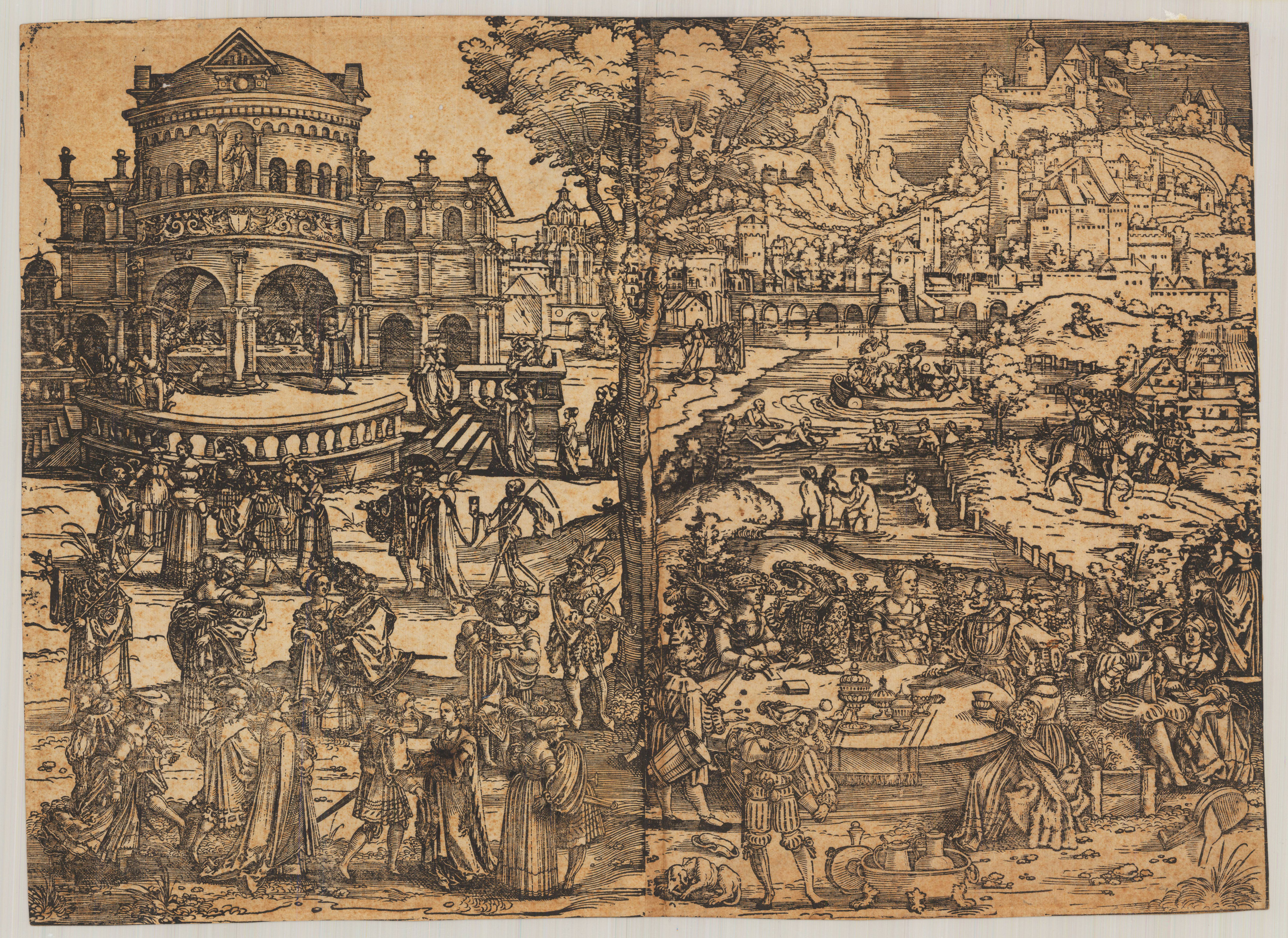
Very rare woodcut (from 2 plates) after H. S. Beham. Not monogr. and dated (around 1550). Almost contemporary woodcut by an unknown master based on the work of Hans Sebald Beham, only differing from the original in small details.
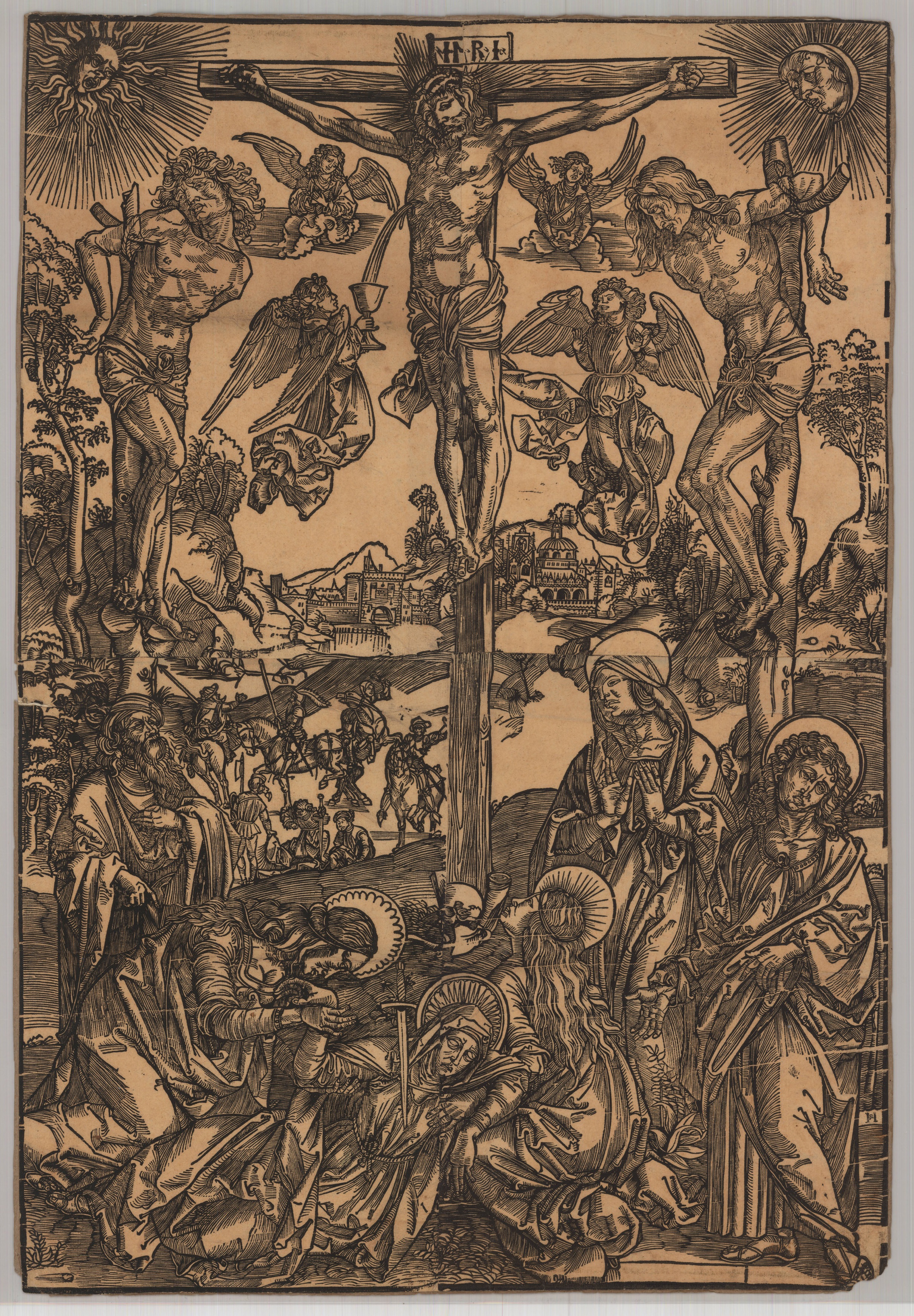
Original woodcut, printed from four woodblocks on laid paper. 2nd state probaly around 1550 printed This is the so-called copy of the large calvary (Der große Berliner Kalvarienberg), a very rare and early woodcut, which is printed from four woodcut blocks. This much discussed large woodcut exists only in eight copies all in public institutions. The original version of it is only known in two copies: in Berlin (Kupferstichkabinett) and in London (British Library). With our example now eleven woodcuts of the large calvary are known. We have compared our copy with the example in the Berliner Kupferstichkabinett and learned that our example must be slightly earlier printed then the one in Berlin. This could be defined clearly by comparing the eruptions in the wood. But none of these 8 known copies do have as our copy an additional monogram: „HS" in the lower right side. The monogram is either cut into the woodblock or was stamped into that gap. This monogram in our woodcut not mentioned in any bibliography or descriptive text about the large calvary. It is looking very similar to the monograms, which Hans Schäufelein was using, who did his apprenticeship in Dürer's worksshop. There is also a „Hans Schwarz" known, the 2nd husband of Hans Schäufelein's widow. Many questions are still open on the authorship of the large calvary, maybe the work could also be attributed to Hans Schäufellein. The authorship and attribution to Albrecht Dürer and the dating of this woodcut is still uncertain, although the woodcut shows several Dürerian motifs, but many extraneous elements speak against an undivided authorship. The design of the woodcut can be dated to the time before Albrecht Dürer's first stay in Venice. Provenance: The woodcut was acquired in the mid 1980's and it was kept in a private collection. The woodcut was backed on thick paper. This was lately perfect removed and we discovered now an old collector's stamp on the reverse in the lower left corner. The laid paper does not show any watermark. We were also able to identify the collector's stamp and can thus close a small gap in the origin story of the woodcut. Lugt 1008 (H. FÜSSLI & Cie, oder FALKEISEN & HUBER.)
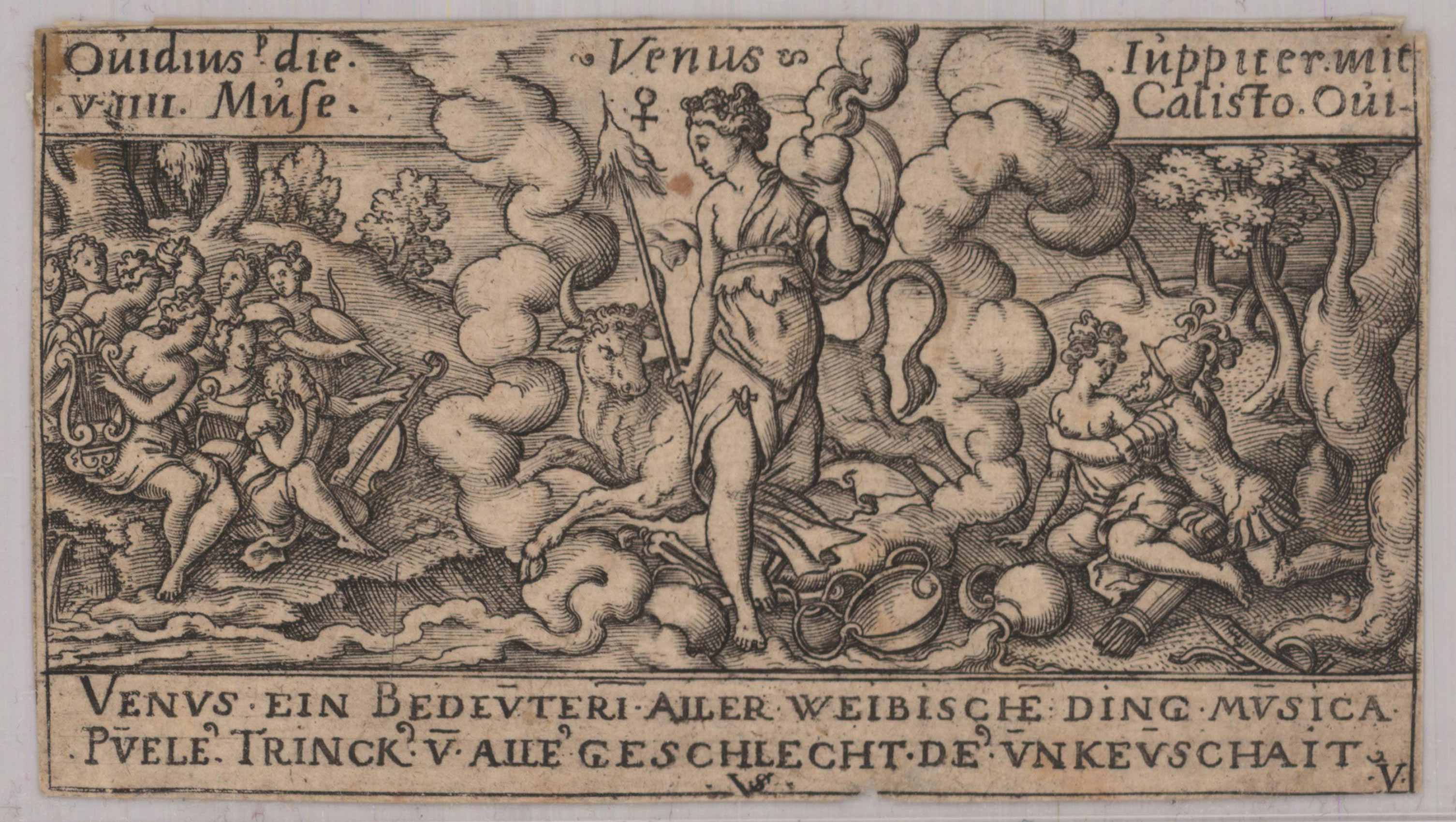
Copper engraving. A fine engraving by one of the so-called minor master engravers Virgil Solis from Nürnberg. The engraving is showing the god Venus with allegoric scenes. Engraved probably between 1530-62.