
Your results
3

Cambriae Typus Auctore Humere Dolhuydo Denbigiense Cambrobritanno
€645.00*
Copper engraving, hand colored in outline and wash. Decorative early map of Wales by the famous Dutch cartographer Gerard Mercator ornated with a renaissance title cartouche, a mileage scale, sea-monsters in the ocean and sailing ships. An early historic rare map of Wales published by Gerard Mercator 1613-16 in his atlas ,Atlas sive Cosmographicae Meditationes de Fabrica Mundi et Fabricati Figura. Denuo auctus - edition quarta.'. This rare map was published for the first time in 1607-08 in Gerard Mercator's atlas and appearred in several editions. Our example is from 1613-16 and has verso French descriptive text.
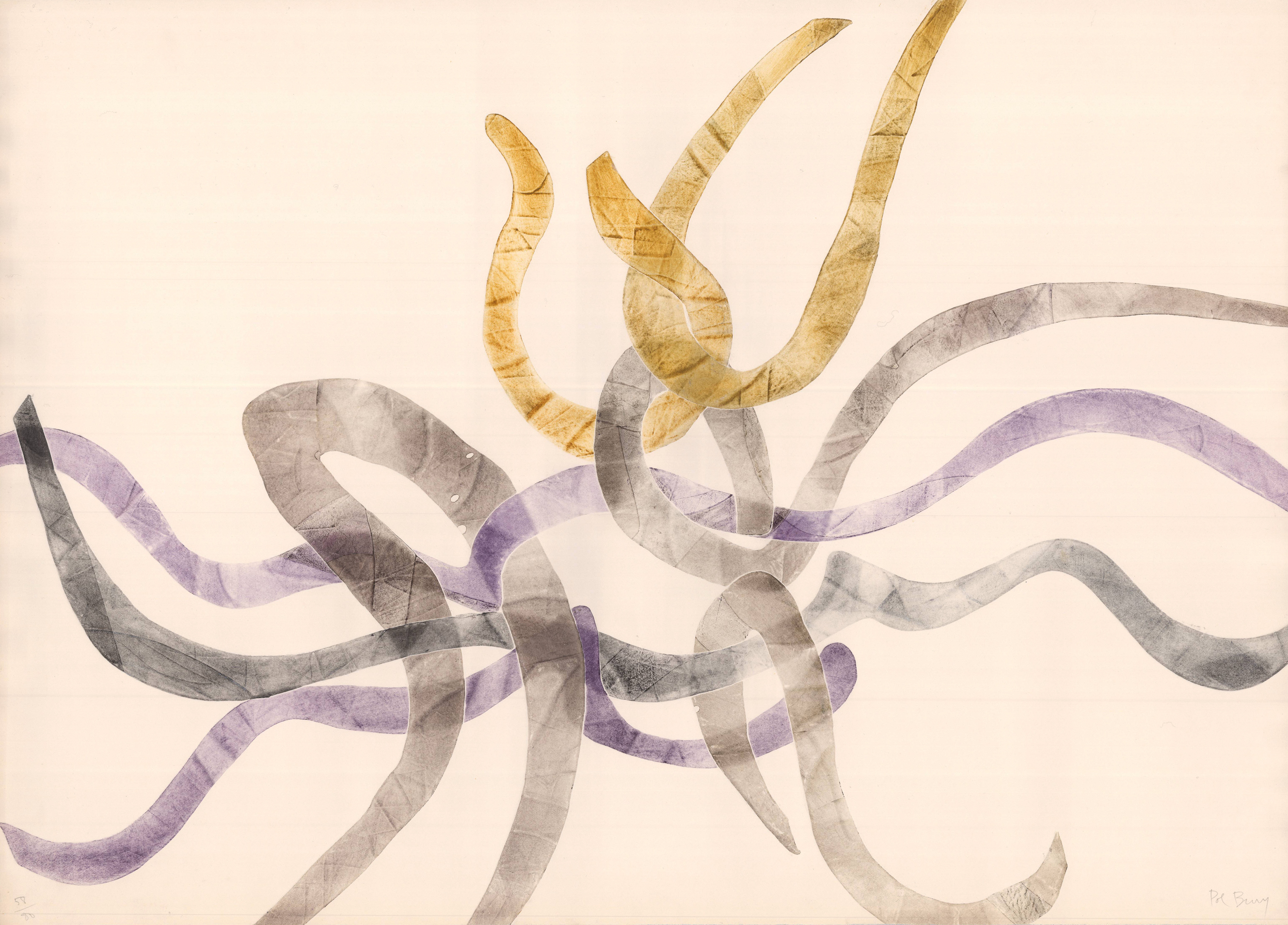
Entrelacés II
€1,800.00*
Original color engraving, signed, numbered 58/80 Original abstract engraving by Pol Bury. Entangled tricolored lines, signed in the lower right, numbered 58/80 in the lower left. Pol Bury (April 26, 1922 in Haine-Saint-Pierre, Belgium – September 28, 2005 in Paris) was a Belgian painter and sculptor. In 1938/39 he studied at the Académie des Beaux-Arts in Mons. In 1939 he was a founding member of the,Group Rapture'. From 1949 to 1951 he was involved in the CoBrA initiative, which was founded in Paris in 1948 by the Danish painter Asger Jorn, the Belgian writer Christian Dotremont and the Dutch painter Karel Appel. After joining the,Art Abstrait' group of artists, he turned away from painting altogether in 1953. In 1957 he developed the first mobile kinetic sculpture with a motor. In 1964 Pol Bury, who had lived in Paris since 1960, represented Belgium at the Venice Biennale. Bury moved to New York from 1966 to 1968. In 1970 he accepted a teaching position at the University of California, Berkeley, and in 1973 he taught at the Minneapolis College of Art and Design, which awarded Pol Bury an honorary doctorate. Since 1983, Pol Bury has been a professor of sculpture at the École national supérieure des beaux-arts de Paris (ENSBA). He took part in the documenta III in Kassel in 1964 and was also represented as an artist at the 4th documenta in 1968. Pol Bury initially belonged to the surrealist and communist movement of abstraction, first as a painter and later as a sculptor. In his first works he was significantly influenced by his compatriots Magritte and Ubac. After retiring from painting in 1953, he established himself as one of the most renowned kinetic artists. Pol Bury creates objects that perform extremely slow movements and thus put perception to the test. He first develops his works as reliefs that depict the movement of serial elements such as discs or pins. The demand and the contemporary public interest in kinetic energies and kinetic art gave birth to his first large objects of monumental sculptures in 1973. Since 1976 he has built numerous fountains, always in the context and on the basis of the basic shapes sphere, cone, cylinder, cube and cuboid. In his graphic works ('Cinétisations', since 1964) he presents the problem of movement. Pol Bury also worked on film between 1968 and 1976, e.g. with Clovis Prevost.

Prospectus amoeniss. vallis Oeniponticae una cum antro in altissima et praeruptissima rupe Imp. Maximiliani primi. - Schlosberg. die Clause in Alpibus Tirolensibus. - Monument. occursus Imp. Caroli V. et Ferdinandi fratis. Depingebat Geor. Houfnaglius.
€480.00*
Hand colored copper engraving, when published in volume V of the townbooks "Civitates Orbis Terrarum" by Braun and Hogenberg. The entire series of the 'Civitates Orbis Terrarum' comprised six volumes and was published and printed from 1572 towards 1619 in Cologne. Copper engraving after a sketch in 1590 by G. Huefnagel. Huefnagel was a very famous artist, whose sketches of towns are outstanding decorative and were often decorated with animals, figures or local people in the foreground. Three decorative views on one doublepage. At the top a view of the Innvalley, with mountains of the Alps in the background. With many details of villages along the river Inn. Below with two small scenes: The 'Schlossberg' and a monument for the emperor Carolus V. Georg Braun (also Brunus, Bruin; 1541 – 10 March 1622) was a topo-geographer. From 1572 to 1617 he edited the Civitates orbis terrarum, which contains 546 prospects, bird's-eye views and maps of cities from all around the world. He was the principal editor of the work, he acquired the tables, hired the artists, and wrote the texts. He died as an octogenarian in 1622, as the only survivor of the original team to witness the publication of volume VI in 1617. Braun was born and died in Cologne. His principal profession was as a Catholic cleric. However, he spent thirty-seven years as canon and dean at the church, St. Maria ad Gradus, in Cologne. His six-volume work was inspired by Sebastian Münster's Cosmographia. In form and layout it resembles the 1570 Theatrum orbis terrarum by Abraham Ortelius, as Ortelius was interested in a complementary companion for the Theatrum. The Braun publication set new standards in cartography for over 100 years. Frans Hogenberg (1535–1590, from Mechelen) created the tables for volumes I through IV, and Simon van den Neuwel created those for volumes V and VI. Other contributors were Joris Hoefnagel, Jacob Hoefnagel, cartographer Daniel Freese, and Heinrich Rantzau. Works by Jacob van Deventer, Sebastian Münster, and Johannes Stumpf were also used. Primarily European cities are depicted in the publication; however, Cairo Casablanca and Mexico City as well as Cuzco on one sheet are also included in volume I, whereas Tunis is featured in volume II. Frans Hogenberg (1535–1590) was a Flemish and German painter, engraver, and mapmaker. Hogenberg was born in Mechelen in Flanders as the son of Nicolaas Hogenberg. In 1568 he was banned from Antwerp by the Duke of Alva and travelled to London, where he stayed a few years before emigrating to Cologne. He is known for portraits and topographical views as well as historical allegories. He also produced scenes of contemporary historical events. Hogenberg died in Cologne. (Wikipedia)