Maria Sibylla Merian is one of the most famous scientists and painters in the 17th century.

Maria Sibylla Merian’s most famous work is the beautiful fine illustrated work about the insects of Surinam published in the beginning of the 18th century. It was published for the first time 1704 with a total of 60 engraved plates.                                                                                                                                                                                                                              

Then it was enlarged with another twelve engravings in the 2nd edition, which was published from 1730 onwards. This famous work is Maria Sibylla Merian’s classic work. Maria S. Merian, born as the daughter of the famous German engraver and publisher Matthäus Merian, devoted herself to the study of insects and their metamorphosis.
Filter
Show products
Your results 72
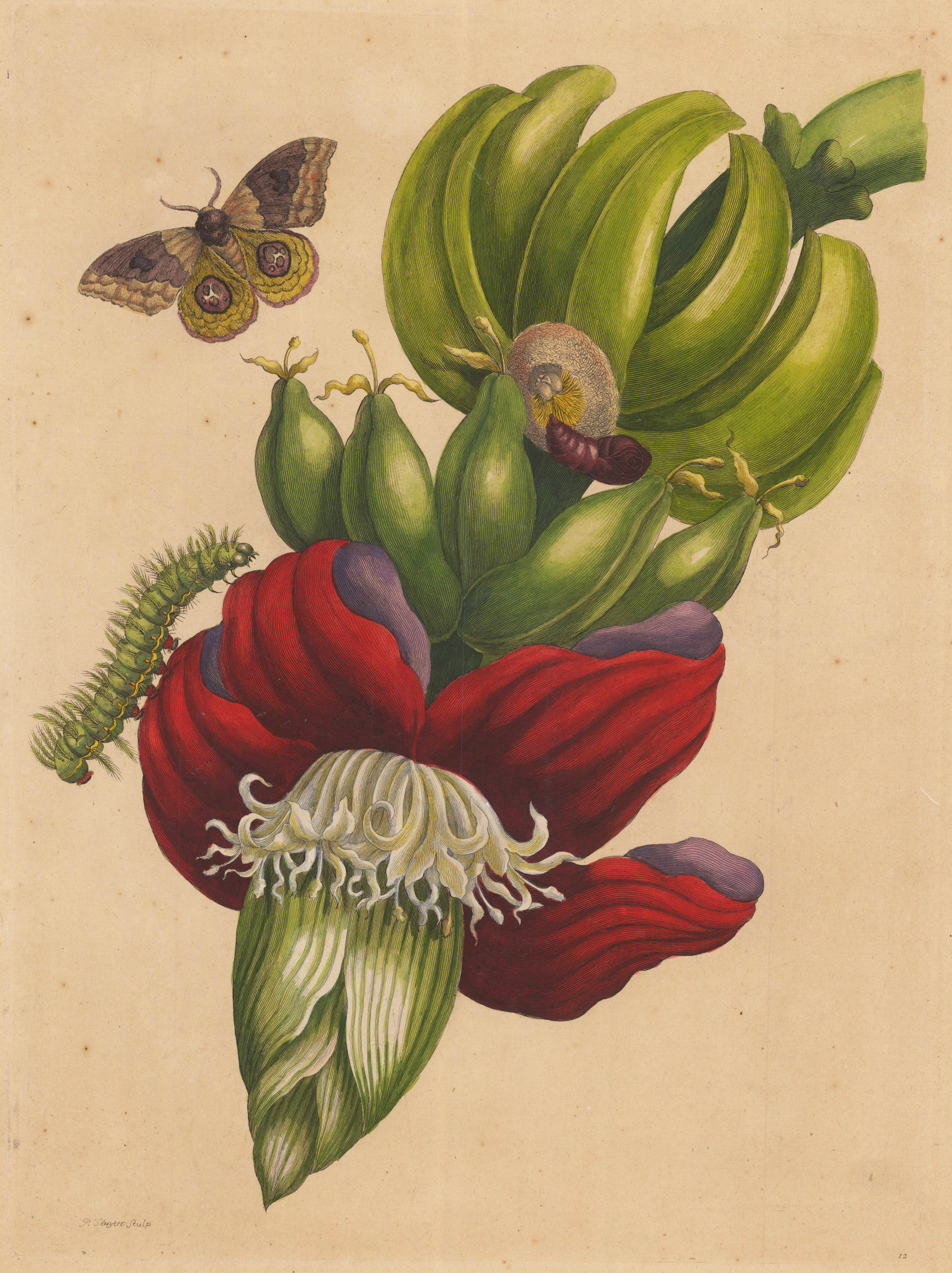
Banana plant Plate 12
Copper engraving, finely hand colored. Finely hand colored copper engraving, published in the famous series 'Over de Voortteeling en Wonderbaerlyke veranderingen der Surinaemsche Insecten'. Maria Sibylla Merian (2 April 1647 – 13 January 1717) was a German-born naturalist and scientific illustrator, a descendant of the Frankfurt branch of the Swiss Merian family, founders of one of Europe's largest publishing houses in the 17th century. Merian received her artistic training from her stepfather, Jacob Marrel, a student of the still life painter Georg Flegel. She remained in Frankfurt until 1670, relocating subsequently to Nuremberg, Wieuwerd (1685), where she stayed in a Labadist community till 1691, and Amsterdam. Merian published her first book of natural illustrations, titled Neues Blumenbuch, in 1675 at age 28. In 1699, following eight years of painting and studying, and on the encouragement of Cornelis van Aerssen van Sommelsdijck, the then-governor of the Dutch colony of Surinam, the city of Amsterdam awarded Merian a grant to travel to South America with her daughter Dorothea. Her trip, designed as a scientific expedition makes Merian perhaps the first person to "plan a journey rooted solely in science." After two years there, malaria forced her to return to Europe. She then proceeded to publish her major work, Metamorphosis insectorum Surinamensium (de), in 1705, for which she became famous. Because of her careful observations and documentation of the metamorphosis of the butterfly, she is considered by David Attenborough to be among the most significant contributors to the field of entomology. She was a leading entomologist of her time and she discovered many new facts about insect life through her studies. (Wikipedia)

€3,300.00*
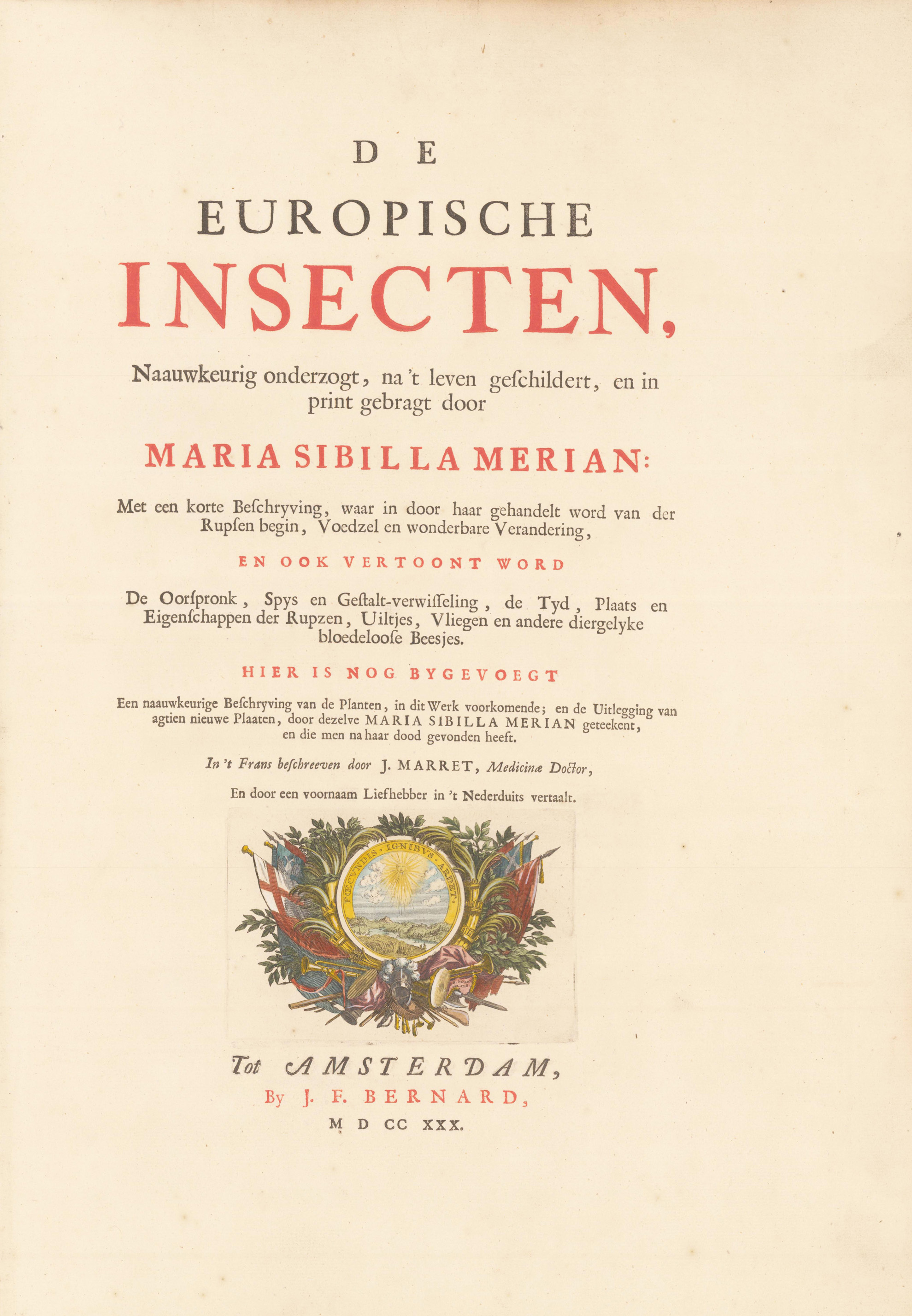
De Europische Insecten, Naauwkeurig onderzogt, na' t leven geschildert, en in print gebragt door Maria Sibilla Merian...
2 leaves, 84 pp.; engraved title- and end-vignette in text, 184 engravings on 47 leaves. First folio edition. Primary leaf (De Europische Insecten), title printed in red and black with hand colored vignette. Illustrated with 184 carefully finely hand colored engravings printed on 47 leaves. Each of the engravings show mostly scenes of decorative flowers and various caterpillars with their appropriate butterflies. The plates originate after Maria Sybilla Merian's own observations and were published for the first time in her 'Raupenbuch', a quart-edition between 1679 und 1717. Maria Sybilla Merian belonged to the first scientists, who watched the insects in a systematic order and she also took a significant part in the investigation of the metamorphosis of the butterflies. With the publication of her books the new knowledge was spread out to a larger circle of the population lived in those days. Theis example is very well preserved, the engravings are probably later colored and are printed on Dutch paper with wide margins in excellent quality. This is the first folio edition and the first appearance of the full suite of Maria Sybilla Merian's plates of the European insects, the companion and complement to her great Surinam work. It is as remarkable for its botanical as for its entomological content: the insects are presented in different stages of metamorphosis on and around flowers. In addition, some Surinamese insects are figured as well, these deriving from Johanna's drawings. Finely hand colored throughout, occasionally minor spotting in text or margins. Rebound in a wine red calf binding, the spine in seven compartments and richly gilt, the covers with decorative blind stamping with gilt fillets to board and spine.

€38,000.00*
Guajave Plate 57
Copper engraving, finely hand colored. A fine engraving from M.S. Merian's classic work. The fruits of the guava are either round or pear-shaped. They are also distinguished by the number of seeds embedded in the soft pulp. The moth Sphinx du tabac with caterpillar and pupa uses the guava as a food plant. She sucks the nectar from the flower in flight. The caterpillar on one of the lower branches, pupates in the ground. The woolly megalopygid caterpillar with the yellow cocoon pictured above belongs to the flannel moth, which mainly inhabits the tropical regions of South America. Maria Sibylla Merian, daughter of the German engraver and publisher Matthäus Merian, devoted herself to the study of European insects and their metamorphoses. As a result of the wealth of tropical varieties being brought back by the Dutch West Indies Company, she decided to visit the Dutch colony of Surinam herself to study and paint the insect life there. She sailed with her daughter Dorothea in June 1699 from Amsterdam, and remained in Surinam until 1701. Also Maria Sibylla Merian's elder daughter Johanna went to Surinam to complete her mothers work. This plate was engraved by P. Sluyter. (Wikipedia)

€1,750.00*
Plate No 26: Cacao
Copper engraving, finely hand colored, published in the famous series 'Over de Voortteeling en Wonderbaerlyke veranderingen der Surinaemsche Insecten' by Maria Sibylla Merian. A fine engraving from Maria Sibylla Merian's classic work. Maria Sibylla Merian, daughter of the German engraver and publisher Matthäus Merian, devoted herself to the study of European insects and their metamorphoses. As a result of the wealth of tropical varieties being brought back by the Dutch West Indies Company, she decided to visit the Dutch colony of Surinam herself to study and paint the insect life there. She sailed with her daughter Dorothea in June 1699 from Amsterdam and remained in Surinam until 1701. Also Maria Sibylla Merian's elder daughter Johanna went to Surinam to complete her mothers work. Most of the plates were engraved by P. Sluyter and J. Mulder, some by P. Stoopendal.

€1,250.00*
Plate No: 1 Ananas
Copper engraving, finely hand colored. Finely hand colored copper engraving, published in the famous series 'Over de Voortteeling en Wonderbaerlyke veranderingen der Surinaemsche Insecten'. A fine engraving from M.S. Merian's classic work. Maria Sybilla Merian, daughter of the German engraver and publisher Matthäus Merian, devoted herself to the study of European insects and their metamorphoses. As a result of the wealth of tropical varieties being brought back by the Dutch West Indies Company, she decided to visit the Dutch colony of Surinam herself to study and paint the insect life there. She sailed with her daughter Dorothea in June 1699 from Amsterdam, and remained in Surinam until 1701. Also Maria Sybilla Merian's elder daughter Johanna went to Surinam to complete her mothers work.

€5,500.00*
Plate No: 10 Cotonier
Copper engraving, finely hand colored, published in the famous series 'Over de Voortteeling en Wonderbaerlyke veranderingen der Surinaemsche Insecten' by Maria Sibylla Merian. A fine engraving from Maria Sibylla Merian's classic work. Maria Sibylla Merian, daughter of the German engraver and publisher Matthäus Merian, devoted herself to the study of European insects and their metamorphoses. As a result of the wealth of tropical varieties being brought back by the Dutch West Indies Company, she decided to visit the Dutch colony of Surinam herself to study and paint the insect life there. She sailed with her daughter Dorothea in June 1699 from Amsterdam and remained in Surinam until 1701. Also Maria Sibylla Merian's elder daughter Johanna went to Surinam to complete her mothers work. Most of the plates were engraved by P. Sluyter and J. Mulder, some by P. Stoopendal.

€1,550.00*
Plate No: 13 Prunier d´Amerique
Copper engraving, finely hand colored, published in the famous series 'Over de Voortteeling en Wonderbaerlyke veranderingen der Surinaemsche Insecten' by Maria Sibylla Merian. A fine engraving from Maria Sibylla Merian's classic work. Maria Sibylla Merian, daughter of the German engraver and publisher Matthäus Merian, devoted herself to the study of European insects and their metamorphoses. As a result of the wealth of tropical varieties being brought back by the Dutch West Indies Company, she decided to visit the Dutch colony of Surinam herself to study and paint the insect life there. She sailed with her daughter Dorothea in June 1699 from Amsterdam and remained in Surinam until 1701. Also Maria Sibylla Merian's elder daughter Johanna went to Surinam to complete her mothers work. Most of the plates were engraved by P. Sluyter and J. Mulder, some by P. Stoopendal.

€1,500.00*
Plate No: 14 Zuursak
Copper engraving, finely hand colored, published in the famous series 'Over de Voortteeling en Wonderbaerlyke veranderingen der Surinaemsche Insecten' by Maria Sibylla Merian. A fine engraving from Maria Sibylla Merian's classic work. Maria Sibylla Merian, daughter of the German engraver and publisher Matthäus Merian, devoted herself to the study of European insects and their metamorphoses. As a result of the wealth of tropical varieties being brought back by the Dutch West Indies Company, she decided to visit the Dutch colony of Surinam herself to study and paint the insect life there. She sailed with her daughter Dorothea in June 1699 from Amsterdam and remained in Surinam until 1701. Also Maria Sibylla Merian's elder daughter Johanna went to Surinam to complete her mothers work. Most of the plates were engraved by P. Sluyter and J. Mulder, some by P. Stoopendal.

€1,350.00*
Plate No: 15 (XV) Melon d´Eau
Copper engraving, finely hand colored, published in the famous series 'Over de Voortteeling en Wonderbaerlyke veranderingen der Surinaemsche Insecten' by Maria Sibylla Merian. A fine engraving from Maria Sibylla Merian's classic work. Maria Sibylla Merian, daughter of the German engraver and publisher Matthäus Merian, devoted herself to the study of European insects and their metamorphoses. As a result of the wealth of tropical varieties being brought back by the Dutch West Indies Company, she decided to visit the Dutch colony of Surinam herself to study and paint the insect life there. She sailed with her daughter Dorothea in June 1699 from Amsterdam and remained in Surinam until 1701. Also Maria Sibylla Merian's elder daughter Johanna went to Surinam to complete her mothers work. Most of the plates were engraved by P. Sluyter and J. Mulder, some by P. Stoopendal.

€1,450.00*
Plate No: 15 Melon d´Eau
Copper engraving, finely hand colored. Finely hand colored copper engraving, published in the famous series 'Over de Voortteeling en Wonderbaerlyke veranderingen der Surinaemsche Insecten'. A fine engraving from M.S. Merian's classic work. Maria Sibylla Merian, daughter of the German engraver and publisher Matthäus Merian, devoted herself to the study of European insects and their metamorphoses. As a result of the wealth of tropical varieties being brought back by the Dutch West Indies Company, she decided to visit the Dutch colony of Surinam herself to study and paint the insect life there. She sailed with her daughter Dorothea in June 1699 from Amsterdam, and remained in Surinam until 1701. Also Maria Sibylla Merian's elder daughter Johanna went to Surinam to complete her mothers work. This plate was engraved by P. Sluyter.

€1,600.00*
Plate No: 15 Melon d´Eau
Copper engraving, finely hand colored, published in the famous series 'Over de Voortteeling en Wonderbaerlyke veranderingen der Surinaemsche Insecten' by Maria Sibylla Merian. A fine engraving from Maria Sibylla Merian's classic work. Maria Sibylla Merian, daughter of the German engraver and publisher Matthäus Merian, devoted herself to the study of European insects and their metamorphoses. As a result of the wealth of tropical varieties being brought back by the Dutch West Indies Company, she decided to visit the Dutch colony of Surinam herself to study and paint the insect life there. She sailed with her daughter Dorothea in June 1699 from Amsterdam and remained in Surinam until 1701. Also Maria Sibylla Merian's elder daughter Johanna went to Surinam to complete her mothers work. Most of the plates were engraved by P. Sluyter and J. Mulder, some by P. Stoopendal.

€1,900.00*
Plate No: 16 Cashu - Arbor Cashou
Copper engraving, finely hand colored, published in the famous series 'Over de Voortteeling en Wonderbaerlyke veranderingen der Surinaemsche Insecten' by Maria Sibylla Merian. A fine engraving from Maria Sibylla Merian's classic work. Maria Sibylla Merian, daughter of the German engraver and publisher Matthäus Merian, devoted herself to the study of European insects and their metamorphoses. As a result of the wealth of tropical varieties being brought back by the Dutch West Indies Company, she decided to visit the Dutch colony of Surinam herself to study and paint the insect life there. She sailed with her daughter Dorothea in June 1699 from Amsterdam and remained in Surinam until 1701. Also Maria Sibylla Merian's elder daughter Johanna went to Surinam to complete her mothers work. Most of the plates were engraved by P. Sluyter and J. Mulder, some by P. Stoopendal.

€1,950.00*
Plate No: 18 (Spiders)
Original counter proof in colors. Branch of a defoliated guava tree with tarantulas, ants and spiders. In printmaking, a counterproof is a print taken off from another just printed, which, by being passed through the press, gives a copy in reverse, and of course in the same position as that of the plate from which the first was printed, the object being to enable the printmaker to inspect the state of the plate. Counterproofing was used to produce the finest quality copperplate printing; the second print consisted of delicate lines, and lacked the beveled impressions seen in the original print. To counter-prove is also to pass a drawn design in black lead or red chalk through the press, after having moistened with a sponge both that and the paper on which the counterproof is to be taken. (Wikipedia) A fine counterproof imprint from Merian´s finest work „Dissertatio de Generatione et Metamorphosibus Insectorum Surinamensium." Peter Dance in „The Art of Natural History", refers to this series as „easily the most magnificent work on insects so far produced... combining sciense and art in equal proportions... „ A counterproof is a technique of pulling an impression from an impression or taking an impression from a freshly printed image that has just been removed from a press before the ink has been allowed to dry. This process allows the artist to replicate as closely as possible the original drawing as they would be oriented in the same direction, show no plate mark an depict only a lightly inked lines. This made them highly suitable for coloring with the end result being as close to the original watercolor as possible. This technique was difficult and time consuming and well as very expensive. This made this production a deluxe or very special edition and was usually reserved for a select few subscribers. This particular edition is rarely seen on the market.

€1,950.00*
Plate No: 18 Spider
Copper engraving, finely hand colored. Finely hand colored copper engraving, published in the famous series 'Over de Voortteeling en Wonderbaerlyke veranderingen der Surinaemsche Insecten'. A fine engraving from M.S. Merian's classic work. Maria Sybilla Merian, daughter of the German engraver and publisher Matthäus Merian, devoted herself to the study of European insects and their metamorphoses. As a result of the wealth of tropical varieties being brought back by the Dutch West Indies Company, she decided to visit the Dutch colony of Surinam herself to study and paint the insect life there. She sailed with her daughter Dorothea in June 1699 from Amsterdam, and remained in Surinam until 1701. Also Maria Sybilla Merian's elder daughter Johanna went to Surinam to complete her mothers work. This plate was engraved by P. Sluyter.

€1,750.00*
Plate No: 20
Copper engraving, finely hand colored. Finely hand colored copper engraving, published in the famous series 'Over de Voortteeling en Wonderbaerlyke veranderingen der Surinaemsche Insecten'. A fine engraving from M.S. Merian's classic work. Maria Sybilla Merian, daughter of the German engraver and publisher Matthäus Merian, devoted herself to the study of European insects and their metamorphoses. As a result of the wealth of tropical varieties being brought back by the Dutch West Indies Company, she decided to visit the Dutch colony of Surinam herself to study and paint the insect life there. She sailed with her daughter Dorothea in June 1699 from Amsterdam, and remained in Surinam until 1701. Also Maria Sybilla Merian's elder daughter Johanna went to Surinam to complete her mothers work. This plate was engraved by P. Sluyter.

€2,450.00*
Plate No: 24 Maccai
Copper engraving, finely hand colored, published in the famous series 'Over de Voortteeling en Wonderbaerlyke veranderingen der Surinaemsche Insecten' by Maria Sibylla Merian. A fine engraving from Maria Sibylla Merian's classic work. Maria Sibylla Merian, daughter of the German engraver and publisher Matthäus Merian, devoted herself to the study of European insects and their metamorphoses. As a result of the wealth of tropical varieties being brought back by the Dutch West Indies Company, she decided to visit the Dutch colony of Surinam herself to study and paint the insect life there. She sailed with her daughter Dorothea in June 1699 from Amsterdam and remained in Surinam until 1701. Also Maria Sibylla Merian's elder daughter Johanna went to Surinam to complete her mothers work. Most of the plates were engraved by P. Sluyter and J. Mulder, some by P. Stoopendal.

€1,800.00*
Plate No: 25 Banille
Copper engraving, finely hand colored, published in the famous series 'Over de Voortteeling en Wonderbaerlyke veranderingen der Surinaemsche Insecten' by Maria Sibylla Merian. A fine engraving from Maria Sibylla Merian's classic work. Maria Sibylla Merian, daughter of the German engraver and publisher Matthäus Merian, devoted herself to the study of European insects and their metamorphoses. As a result of the wealth of tropical varieties being brought back by the Dutch West Indies Company, she decided to visit the Dutch colony of Surinam herself to study and paint the insect life there. She sailed with her daughter Dorothea in June 1699 from Amsterdam and remained in Surinam until 1701. Also Maria Sibylla Merian's elder daughter Johanna went to Surinam to complete her mothers work. Most of the plates were engraved by P. Sluyter and J. Mulder, some by P. Stoopendal.

€980.00*
Plate No: 26 Cacau boom
Copper engraving, finely hand colored, published in the famous series 'Over de Voortteeling en Wonderbaerlyke veranderingen der Surinaemsche Insecten' by Maria Sibylla Merian. A fine engraving from Maria Sibylla Merian's classic work. Maria Sibylla Merian, daughter of the German engraver and publisher Matthäus Merian, devoted herself to the study of European insects and their metamorphoses. As a result of the wealth of tropical varieties being brought back by the Dutch West Indies Company, she decided to visit the Dutch colony of Surinam herself to study and paint the insect life there. She sailed with her daughter Dorothea in June 1699 from Amsterdam and remained in Surinam until 1701. Also Maria Sibylla Merian's elder daughter Johanna went to Surinam to complete her mothers work. Most of the plates were engraved by P. Sluyter and J. Mulder, some by P. Stoopendal.

€1,100.00*
Plate No: 26 Cacau boom
Copper engraving, finely hand colored, published in the famous series 'Over de Voortteeling en Wonderbaerlyke veranderingen der Surinaemsche Insecten' by Maria Sibylla Merian. A fine engraving from Maria Sibylla Merian's classic work. Maria Sibylla Merian, daughter of the German engraver and publisher Matthäus Merian, devoted herself to the study of European insects and their metamorphoses. As a result of the wealth of tropical varieties being brought back by the Dutch West Indies Company, she decided to visit the Dutch colony of Surinam herself to study and paint the insect life there. She sailed with her daughter Dorothea in June 1699 from Amsterdam and remained in Surinam until 1701. Also Maria Sibylla Merian's elder daughter Johanna went to Surinam to complete her mothers work. Most of the plates were engraved by P. Sluyter and J. Mulder, some by P. Stoopendal.

€1,250.00*
Plate No: 27 Pomme d Sodome - Pommum Sodomae
Copper engraving, finely hand colored, published in the famous series 'Over de Voortteeling en Wonderbaerlyke veranderingen der Surinaemsche Insecten' by Maria Sibylla Merian. A fine engraving from Maria Sibylla Merian's classic work. Maria Sibylla Merian, daughter of the German engraver and publisher Matthäus Merian, devoted herself to the study of European insects and their metamorphoses. As a result of the wealth of tropical varieties being brought back by the Dutch West Indies Company, she decided to visit the Dutch colony of Surinam herself to study and paint the insect life there. She sailed with her daughter Dorothea in June 1699 from Amsterdam and remained in Surinam until 1701. Also Maria Sibylla Merian's elder daughter Johanna went to Surinam to complete her mothers work. Most of the plates were engraved by P. Sluyter and J. Mulder, some by P. Stoopendal.

€1,750.00*
Plate No: 29 Pompelmous
Copper engraving, finely hand colored. Finely hand colored copper engraving, published in the famous series 'Over de Voortteeling en Wonderbaerlyke veranderingen der Surinaemsche Insecten'. A fine engraving from M.S. Merian's classic work. Maria Sibylla Merian, daughter of the German engraver and publisher Matthäus Merian, devoted herself to the study of European insects and their metamorphoses. As a result of the wealth of tropical varieties being brought back by the Dutch West Indies Company, she decided to visit the Dutch colony of Surinam herself to study and paint the insect life there. She sailed with her daughter Dorothea in June 1699 from Amsterdam, and remained in Surinam until 1701. Also Maria Sibylla Merian's elder daughter Johanna went to Surinam to complete her mothers work. This plate was engraved by P. Sluyter.

€1,750.00*
Plate No: 3
Copper engraving, finely hand colored, published in the famous series 'Over de Voortteeling en Wonderbaerlyke veranderingen der Surinaemsche Insecten' by Maria Sibylla Merian. A fine engraving from Maria Sibylla Merian's classic work. Maria Sibylla Merian, daughter of the German engraver and publisher Matthäus Merian, devoted herself to the study of European insects and their metamorphoses. As a result of the wealth of tropical varieties being brought back by the Dutch West Indies Company, she decided to visit the Dutch colony of Surinam herself to study and paint the insect life there. She sailed with her daughter Dorothea in June 1699 from Amsterdam and remained in Surinam until 1701. Also Maria Sibylla Merian's elder daughter Johanna went to Surinam to complete her mothers work. Most of the plates were engraved by P. Sluyter and J. Mulder, some by P. Stoopendal.

€1,600.00*
Plate No: 31
Copper engraving, finely hand colored. Finely hand colored copper engraving, published in the famous series 'Over de Voortteeling en Wonderbaerlyke veranderingen der Surinaemsche Insecten'. A fine engraving from M.S. Merian's classic work. Maria Sybilla Merian, daughter of the German engraver and publisher Matthäus Merian, devoted herself to the study of European insects and their metamorphoses. As a result of the wealth of tropical varieties being brought back by the Dutch West Indies Company, she decided to visit the Dutch colony of Surinam herself to study and paint the insect life there. She sailed with her daughter Dorothea in June 1699 from Amsterdam, and remained in Surinam until 1701. Also Maria Sybilla Merian's elder daughter Johanna went to Surinam to complete her mothers work. This plate was engraved by P. Sluyter.

€2,200.00*
Plate No: 33 Figuir d´Amerique
Copper engraving, finely hand colored, published in the famous series 'Over de Voortteeling en Wonderbaerlyke veranderingen der Surinaemsche Insecten' by Maria Sibylla Merian. A fine engraving from Maria Sibylla Merian's classic work. Maria Sibylla Merian, daughter of the German engraver and publisher Matthäus Merian, devoted herself to the study of European insects and their metamorphoses. As a result of the wealth of tropical varieties being brought back by the Dutch West Indies Company, she decided to visit the Dutch colony of Surinam herself to study and paint the insect life there. She sailed with her daughter Dorothea in June 1699 from Amsterdam and remained in Surinam until 1701. Also Maria Sibylla Merian's elder daughter Johanna went to Surinam to complete her mothers work. Most of the plates were engraved by P. Sluyter and J. Mulder, some by P. Stoopendal.

€1,900.00*