
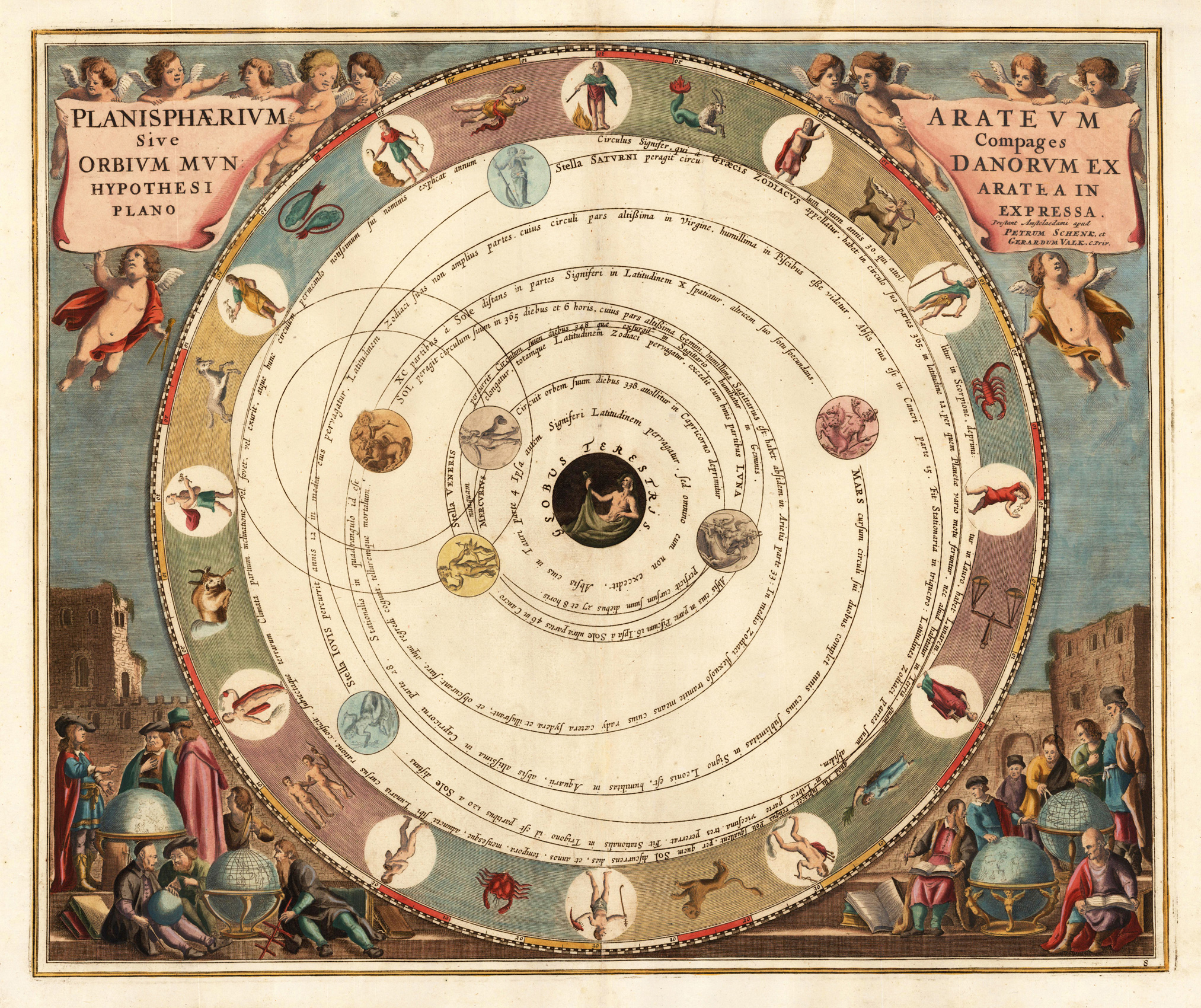
Planisphaerium Arateum Sive Compages Oribum Mundanorum Exhypothesi Aratea in Plano Expressa. Prostant Amstelaedami apud Petrum Schenk, et Gerardum Valk. C. Priv.
Product information: Planisphaerium Arateum Sive Compages Oribum Mundanorum Exhypothesi Aratea in Plano Expressa. Prostant Amstelaedami apud Petrum Schenk, et Gerardum Valk. C. Priv.
Original antique copper engraving, hand colored in outline and wash. Circular celestial chart of the classical solar system, published in the Harmonia Macrocosmica seu Atlas Universalis et Novus. The title is engraved over two banderoles in upper corners. Artronomers and students studying celestial and terrestrial globes in the lower corners. Andreas Cellarius (c. 1596, Neuhausen, – 1665, Hoorn) was a Dutch-German cartographer, best known for his Harmonia Macrocosmica of 1660, a major star atlas, published by Johannes Janssonius in Amsterdam. Andreas Cellarius, illustration of the Copernican system, from the Harmonia Macrocosmica (1660). He was born in Neuhausen (now a part of Worms), and was educated in Heidelberg. The Protestant Cellarius may have left Heidelberg at the onset of the Thirty Years' War in 1618 or in 1622 when the city came in Catholic hands. His activities are unclear at this time but based on his later works it is conjectured he spent time in Poland and may have even worked as a military engineer there. In 1625 he married Catharina Elt(e)mans in Amsterdam, where he worked as school master of a Latin School. After a brief stay in The Hague, the family moved to Hoorn. From 1637 until his death he was rector of the Latin School in Hoorn, where Pieter Anthoniszoon Overtwater was conrector. He published on fortification and on Poland. The minor planet 12618 Cellarius is named in his honour. (Wikipedia)
Properties
| Issue date: | 1708 |
|---|---|
| Published place: | Amsterdam |
| Publisher: | P. Schenk |
| Technique: | Copper engraving / later hand color |
| Type: | Antique Map, map |